
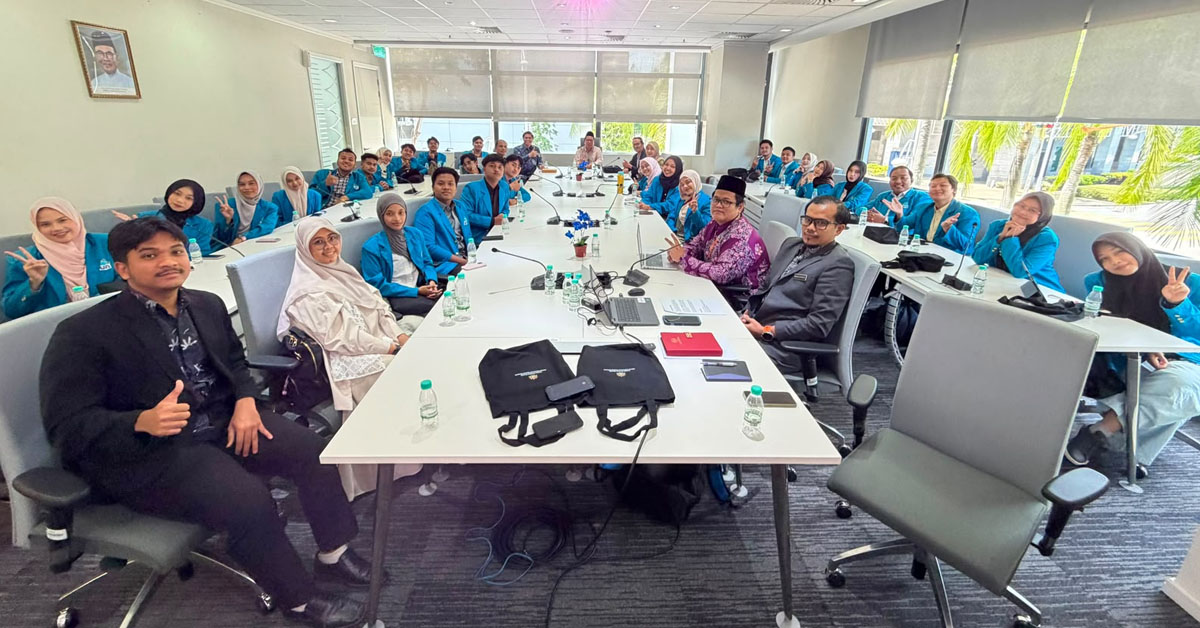
28 FSH UIN Jakarta Students Learn Malaysia’s Sharia Judicial System at JKSM
FSH News, Putrajaya – How does Malaysia’s Sharia judicial system work, and to what extent does it provide justice for society? These questions became part of the academic experience of 28 students from the Faculty of Sharia and Law (FSH), UIN Syarif Hidayatullah Jakarta, during their visit to the Jabatan Kehakiman Syariah Malaysia (JKSM) on Thursday, August 6, 2026.
The visit was one of the key agendas in the International Student Mobility program of FSH UIN Jakarta in Malaysia. Students not only learned about the Sharia judiciary institution from an organizational perspective but also gained direct insights into its structure, functions, authority, and governance practices.
The delegation was led by Vice Dean for Student Affairs, Alumni, and Cooperation, Prof. Dr. Kamarusdiana, M.H., accompanied by lecturers and 28 students, coordinated by student representative Muhammad Fikri Ramadhan. From Universiti Malaya (UM), Assoc. Prof. Dr. Mohd Zaidi bin Daud, Head of the Department of Sharia and Law at APIUM, also joined, adding academic depth to the visit.
The group was welcomed by YBrs. Tuan Mohd Ridzwan bin Ghazali, Head of the Basic and Research Division (BDP) of JKSM, representing the institution’s leadership.
The program, starting at 10:00 local time, was coordinated with several JKSM units, including the Basic and Research Division (BDP), Registration, Secretariat and Records Division (BPKR), and the Corporate Communications Unit (UKK).
In his welcome remarks, JKSM emphasized its commitment to strengthening institutional governance and the quality of Sharia justice delivery, aligning with Malaysia’s MADANI aspirations.
For FSH UIN Jakarta students, the presentations offered a direct look at how Malaysia’s Sharia judicial system is structured and managed. They learned about organizational divisions, functional roles, and the institution’s contribution to Sharia court administration. This provided new perspectives beyond classroom theory.
The visit also allowed students to compare Malaysia’s Sharia judiciary with Indonesia’s religious court system, broadening their understanding of Islamic legal institutions in Southeast Asia.
The JKSM visit exemplified how FSH UIN Jakarta’s student mobility program goes beyond academic activities within universities. Students were encouraged to step outside the classroom to observe institutions that form part of the Sharia legal ecosystem.
This experience connected theoretical knowledge with institutional practice, showing how concepts of judicial administration, authority, legal policy, and justice delivery are applied in a different system.
Interactions with JKSM officials highlighted that the development of Sharia law requires strong institutional governance. Judicial quality depends not only on legal substance but also on how institutions manage administration, research, documentation, and public communication.
The JKSM visit was part of the International Student Mobility program held from August 4–8, 2026. In addition to JKSM, the delegation also engaged in academic and institutional activities at Universiti Malaya and Universiti Sains Islam Malaysia.
These activities aimed to expand students’ learning experiences through direct interaction with international academic and legal institutions.
Through cross-country exposure, students were expected not only to understand Islamic law in Indonesia but also to view Sharia and legal developments from broader perspectives.
For FSH UIN Jakarta, International Student Mobility is a strategic instrument to prepare graduates with strong academic competence, international experience, comparative legal insights, and readiness to face global legal dynamics.
For the 28 students, the JKSM visit was more than an institutional agenda it was an opportunity to witness firsthand how Sharia justice is managed in a different system, enriching their perspectives on the future of Islamic law in Indonesia and Southeast Asia.