
Criminal Law Expert Explains New Paradigm of Indonesia’s Criminal Code at Public Lecture at UIN Jakarta
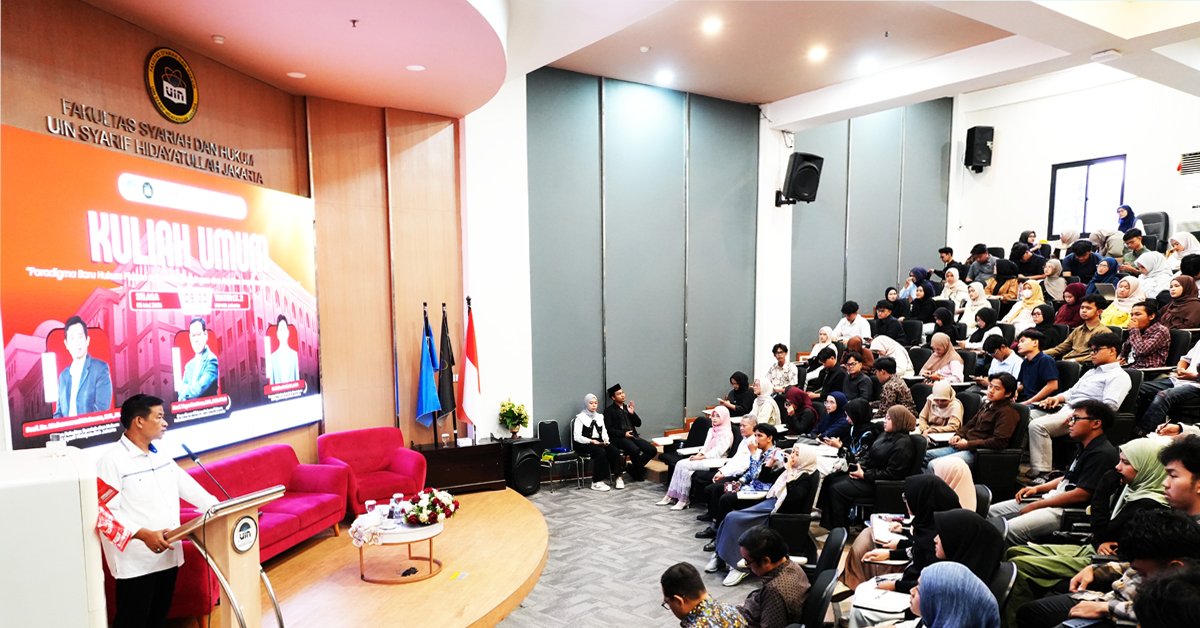
FSH News, 2th Room Theater - The Faculty of Sharia and Law at UIN Syarif Hidayatullah Jakarta held a public lecture titled “A New Paradigm of Indonesian Law: Challenges and Realities in the Implementation of the National Criminal Code”, featuring Prof. Topo Santoso, a prominent criminal law expert and member of the team that drafted Indonesia’s new Criminal Code (KUHP), which officially came into force on January 2, 2026.
The event was organized by the Faculty’s Law and Islamic Criminal Law Study Programs on Wednesday, May 6, 2026, at the second-floor theater room of the Faculty of Sharia and Law.
The public lecture was attended by Vice Rector I for Administration, Prof. Dr. H. Ahmad Tholabi Kharlie, S.Ag., S.H., M.H., M.A.; Head of the Law Study Program, Fitria, S.H., M.R.; Secretary of the Law Study Program, Mara Sultan Rambe, M.H.; Head of the Islamic Criminal Law Study Program, Dr. Qosim Arsadani, M.A.; and Secretary of the Islamic Criminal Law Study Program, Dr. Abu Tamrin, S.H., M.Hum. Around 130 students from the two study programs also took part in the event.
In his opening remarks, Dean of the Faculty of Sharia and Law, Prof. Dr. Muhammad Maksum, M.A., MDC., stressed the importance of developing a comprehensive understanding of the new Criminal Code. He noted that the reform of Indonesia’s criminal law has generated a range of debates and responses within society.
“When we discuss the new Criminal Code, there are provisions that some people welcome, while others consider burdensome. Issues that we often hear about and discuss include the criminalization of unregistered marriages, as well as broader questions concerning freedom of expression including criticism of the president and the boundaries of what constitutes blasphemy,” he said.
He further emphasized that understanding the new criminal legislation accurately is an important task for the entire academic community. Students were also encouraged to stop relying on the old Criminal Code as a reference when preparing academic papers and research.
The Dean explained that the event was prompted in part by the continued use of outdated legal references by some students. Digital sources, including search engines and artificial intelligence tools, are not always fully updated and may still refer to provisions from the former Criminal Code. Providing accurate and up-to-date legal information is therefore considered particularly important for students in the Law Study Program.
During the main session, moderated by M. Ridho Illahi, S.H., M.H., a lecturer at the Faculty of Sharia and Law, Prof. Topo Santoso highlighted the paradigm shift from the colonial-era Criminal Code to a national Criminal Code designed to better reflect Indonesia’s legal and social context.
He explained that Book One of the new Criminal Code establishes fundamental principles, doctrines, and theories that serve as the foundation for criminal legislation in Indonesia.
Among the key changes are the clearer separation between criminal acts and criminal liability, reflecting a dualist approach; more explicit provisions concerning grounds for justification and grounds for exemption from criminal liability; and the recognition of corporate criminal liability.
The new Criminal Code also incorporates the concept of living law in society, including customary criminal law as recognized through regional regulations.
Regarding the transition to the new legal framework, the lecture explained that newly initiated cases will be governed by the new Criminal Code, while ongoing cases will continue to be subject to the provisions that are most favorable to the defendant.
The public lecture also featured an interactive question-and-answer session. Prof. Topo Santoso responded to questions from participants on a range of issues, including the balance between living law and the principle of legality, the legal status of animals in the context of self-defense, and the scope of territorial jurisdiction, including the handling of cybercrimes that have an impact in Indonesia.
The event is expected to strengthen students’ understanding of developments in Indonesia’s national criminal law and encourage the use of accurate and up-to-date legal references in academic work.