
Dean of FSH UIN Jakarta: Political Fiqh Must Be Directed Toward National Legal Solutions
FSH News, Meeting Room 2nd Floor — The Dean of the Faculty of Sharia and Law (FSH) at UIN Syarif Hidayatullah Jakarta, Prof. Muhammad Maksum, emphasized that political fiqh needs to be developed contextually so that Islamic values can be translated into inclusive national legal solutions that bring benefit to all members of society.
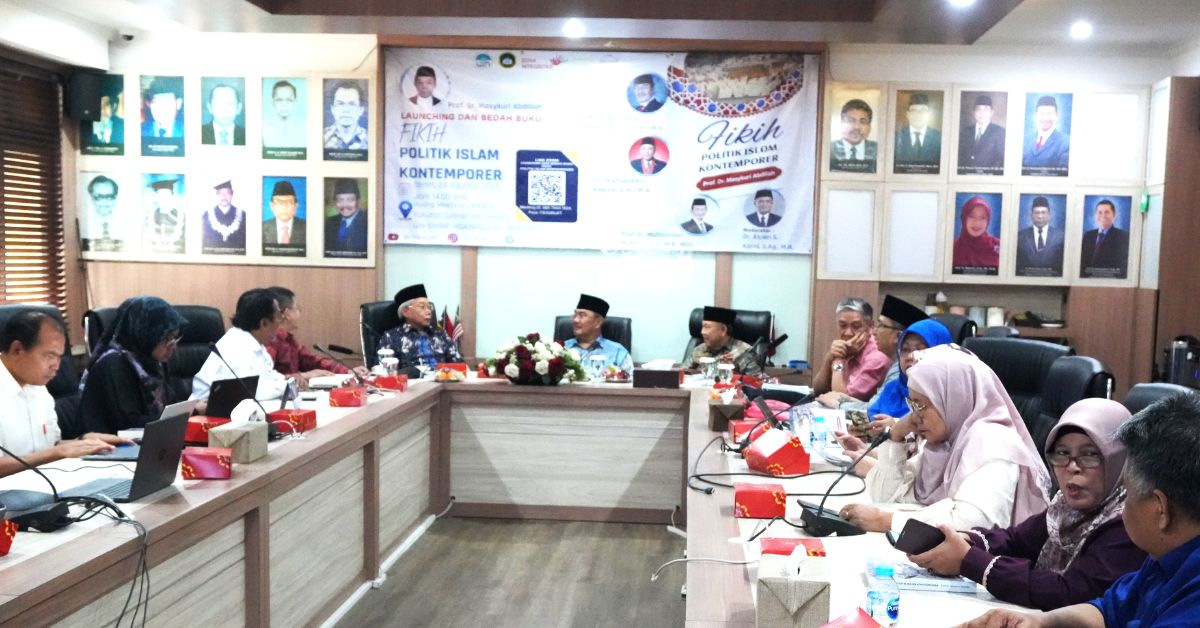
This statement was delivered by Prof. Muhammad Maksum during the closing of the book review of Contemporary Islamic Political Fiqh by Prof. Masykuri Abdillah at UIN Syarif Hidayatullah Jakarta, Monday (August 24, 2026). The event featured Prof. Jimly Asshiddiqie and Dr. Wahiduddin Adams as discussants, with Dr. Asrori S. Karni as moderator.
According to Maksum, debates about the relationship between Islam and the state will continue in Indonesia, whether in the context of politics, economics, institutions, or law. These debates lie between the desire to preserve Islamic identity and the effort to accommodate Islamic values within the constitution, legislation, and state policies.
“Debates about Islam, whether in politics, economics, institutions, or other fields, I believe will continue and will not end in Indonesia,” said Maksum.
He stressed that the main challenge of political fiqh is not merely debating symbols or Islamic labels, but how those values can be formulated into policies and laws that benefit society. He cited the development of Islamic economics as an example, which has been relatively well accepted because it provides tangible benefits in business, financing, investment, and public welfare.
On the other hand, applying Islamic values in politics and criminal law is more sensitive, as it involves power, citizens’ freedoms, societal pluralism, the limits of state authority, and protection of minority groups.
“The existence of Islamic-oriented legal drafts within the framework of national law is interesting. Our society is plural. All interests must be able to enter and be considered,” Maksum explained.
He argued that studies of political fiqh must produce a mature construction of national law that considers the constitution, societal needs, protection of citizens’ rights, and the regulatory system. Religious values cannot simply be transformed into state norms without attention to legal elements, subjects, authority, sanctions, and mechanisms of legal protection.
This perspective aligns with Prof. Masykuri Abdillah’s thought, which places political fiqh as a field of ijtihad open to change. In his 470-page book, Masykuri discusses various issues of contemporary Islamic politics, including nation-state and caliphate, constitution, power, state finance, jihad, citizenship, equality, freedom, political parties, opposition, pluralism, democracy, and political ethics.
Masykuri explained that his book uses both normative and contextual approaches. Religious texts, he argued, must be read by considering the context in which they emerged as well as today’s social realities.
“We must look at the text, the context, and the interpretation: what was the context then, what is it now, and how should we respond,” Masykuri stated.
He also distinguished between an Islamic state and a Muslim state. An Islamic state formally enforces sharia as positive law, while a Muslim state is one where the majority of citizens are Muslim. This distinction is important to avoid forcing Islam into a single uniform model of statehood.
Meanwhile, Prof. Jimly Asshiddiqie emphasized the importance of integrating fiqh with legal science in developing contemporary political fiqh. He argued that religious values must engage in dialogue with constitutionalism, democracy, human rights, social sciences, and historical experience.
“Many aspects of legal science and fiqh need to be carefully integrated,” Jimly noted.
He also pointed out that applying Islamic values does not always require the “sharia” label. Indonesia has already adopted various Islamic principles through regulations on zakat, waqf, hajj, Islamic banking, halal product assurance, and even state securities. Thus, justice and public benefit should be the key measures in applying Islamic values in governance.
Dr. Wahiduddin Adams highlighted the importance of using Indonesia’s experience as a source for developing political fiqh. The establishment of religious courts and the incorporation of sharia principles into several laws demonstrate that religious values can be applied through constitutional processes.
He reminded participants that the 1945 Constitution brings together popular sovereignty, legal sovereignty, and divine values. These three must be understood as complementary, not contradictory.
The nearly three-hour discussion was attended both onsite and online. Present onsite were Dean Prof. Muhammad Maksum, Vice Deans Prof. Kamarusdiana and Dr. Afwan Faizin, Head of the Doctoral Program in Sharia Studies Prof. Yayan Sopyan, and around 30 members of UIN Jakarta’s academic community. Online participants included Vice Rector I Prof. Ahmad Tholabi and Head of the Center for Fatwa and Islamic Law Studies (Pusfahim) Prof. Asrorun Ni’am. The discussion was interactive, with responses and questions from participants.
The book review underscored that the future of political fiqh should not be confined to identity politics but must move toward politics of public benefit. Islamic values are expected to contribute to justice, legal certainty, protection of citizens’ rights, and collective welfare within Indonesia’s national legal framework.