
Djuanda Forum by LKBH FSH UIN Jakarta Proposes Omnibus Law on Land and Forest Fire Management
FSH NEWS, LKBH Room – A legal breakthrough is needed to address the recurring land and forest fires (Karhutla) across various regions in Indonesia every year. The fragmentation of regulations has been a primary cause of the chaos in handling Karhutla.
Ferdian Andi, a lecturer in the Constitutional Law Program (HTN) at the Faculty of Sharia and Law (FSH) UIN Jakarta, stated that the chaotic management of Karhutla stems from regulatory fragmentation scattered across various laws and involving multiple sectors.
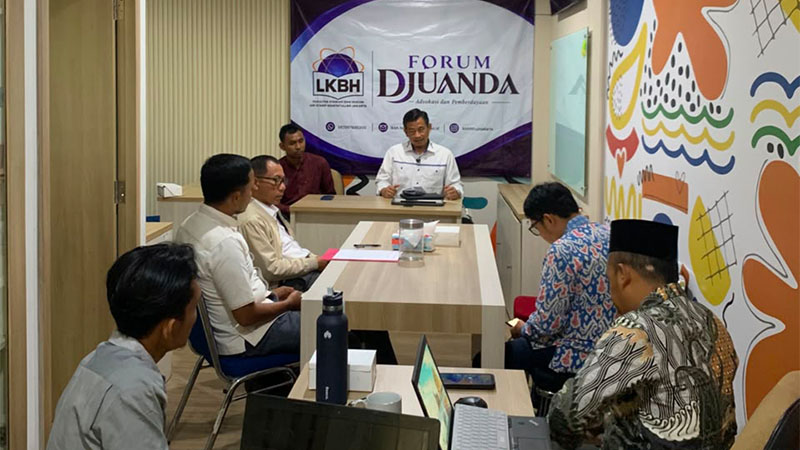
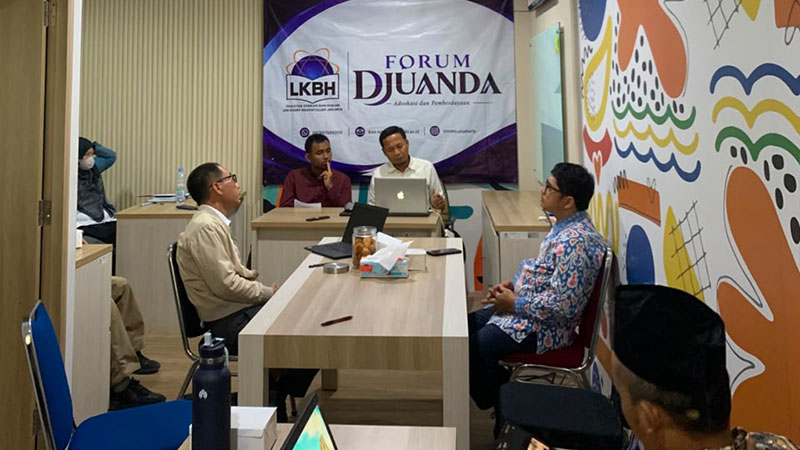
“There are eight scattered regulations across Laws, Government Regulations, and Ministerial Regulations regarding Karhutla. The omnibus law method aims to integrate these cross-sectoral issues,” Ferdian said during the "Djuanda Forum" discussion hosted by the Legal Consultation and Aid Institute (LKBH) of the Faculty of Sharia and Law UIN Jakarta, Monday (Sep 7, 2026).
He specified the eight regulations, which include Law No. 41 of 1999 on Forestry, Law No. 32 of 2009 on Environmental Protection and Management (PPLH), Government Regulation No. 4 of 2001 on Environmental Damage and/or Pollution Control Related to Land and Forest Fires, Law No. 26 of 2007 on Spatial Planning, Law No. 39 of 2014 on Plantations, Government Regulation No. 71 of 2014 on the Protection and Management of Peat Ecosystems, Regulation of the Minister of Environment and Forestry No. P.32/menlhk/setjen/kum.1/3/2016 on Forest and Land Fire Control, and Law No. 23 of 2014 on Regional Government.
Furthermore, Ferdian emphasized that fire hazards do not operate in sectoral silos; hence, connectivity between norms scattered across various regulations is required. “The current approach to handling Karhutla uses a pattern of 'fire occurrence, response, and law enforcement,' which needs to shift toward risk management. Thus, what is needed is not merely a regulation on Karhutla management, but rather a regulation on Karhutla Risk Management that integrates norms related to the fire risk cycle,” Ferdian asserted.
He added that the new regulation using the omnibus law method is expected to adopt a green legislation paradigm oriented toward sustainable development. “Therefore, the Omnibus Law must embody the spirit of green legislation,” Ferdian stressed.
During the discussion, the Head of LKBH, Abdul Aziz, reminded that forest land management contains crucial points. According to him, the Omnibus Law must proportionally position all institutions related to forest and land management. “The position of the National Land Agency (BPN) in this Omnibus Law regulation must be clear to avoid inter-institutional overlap,” Aziz reminded.
Meanwhile, on the same occasion, the Dean of the Faculty of Sharia and Law at UIN Syarif Hidayatullah Jakarta, Prof. Dr. Muhammad Maksum, expressed hope that the Djuanda Forum initiated by LKBH FSH UIN Jakarta would be able to integrate science-based academic studies with public advocacy. “Universities must not distance themselves from the community. This Djuanda Forum aims to bridge scientific knowledge and direct advocacy to the public,” Prof. Maksum affirmed.
The Djuanda Forum is a discussion and study space initiated by LKBH FSH UIN Syarif Hidayatullah Jakarta to address legal matters, public policy, and societal issues. The name Djuanda was inspired by Ir. H. Djuanda Kartawidjaja as a symbol of constitutional statecraft, sovereignty, and the courage to fight for legal ideas, while also referring to Jl. Ir. H. Djuanda as the identity of the UIN Syarif Hidayatullah Jakarta campus.