
Dr. Qosim Arsyadani Discusses NU and Muhammadiyah Fatwa Responses to Modern Economy at International Forum USIM
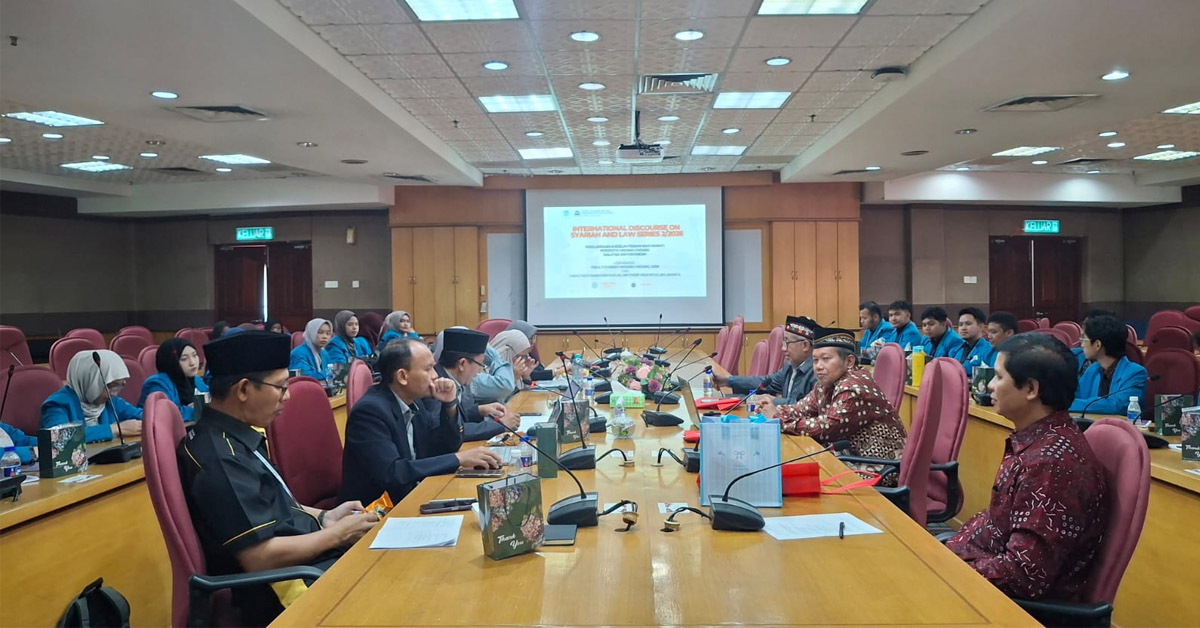
FSH News, Negeri Sembilan – The development of the modern economy has produced new issues that do not always have direct answers in classical fiqh scholarship. Amid these changes, fatwa institutions are required to provide legal responses that are consistent, responsible, and relevant to societal needs. This was the focus of Dr. Qosim Arsyadani, M.A., lecturer at the Faculty of Sharia and Law (FSH), UIN Syarif Hidayatullah Jakarta, in an international forum at Universiti Sains Islam Malaysia (USIM) on Wednesday, August 5, 2026.
At the International Discourse Syariah and Law Series 2, Dr. Qosim presented the theme “Responsibility and Consistency of LBM NU and Muhammadiyah’s Tarjih Council in Responding to Modern Economic Issues.” Addressing academics and students from Indonesia and Malaysia, he examined how Indonesia’s two major fatwa institutions respond to the complexities of contemporary economic issues while maintaining methodological consistency in producing legal rulings.
According to Dr. Qosim, the increasingly complex economy requires fatwa responses that not only provide legal certainty but also interpret societal changes. In Indonesia, the Lembaga Bahtsul Masail Nahdlatul Ulama (LBM NU) and Muhammadiyah’s Majelis Tarjih dan Tajdid each have distinct methodological approaches in addressing modern economic challenges.
Dr. Qosim explained that LBM NU employs approaches such as qawlī, ilḥaqī, and manhajī. Meanwhile, Muhammadiyah applies bayani, tahlili, and istislahi methods in its legal decision-making.
These developments show that fatwa traditions in Indonesia are not static. Methodologies continue to adapt to emerging issues, including those in economics influenced by technological advances, new business models, and evolving social transactions.
He emphasized that both NU and Muhammadiyah demonstrate academic and religious responsibility in guiding society. Differences in approach do not merely reflect divergent orientations but enrich the intellectual heritage of Islamic legal thought in Indonesia. "Responding to modern economic issues requires the ability to read both texts and realities. Therefore, developing fatwa methodology is crucial so that Islamic law remains relevant in addressing societal challenges," Dr. Qosim stated.
He also highlighted Muhammadiyah’s evolving methodology, shifting from a monodisciplinary to a multidisciplinary approach, reflecting the need to integrate diverse scholarly perspectives in understanding increasingly complex economic issues.