
Empowering Law Students: FSH UIN Jakarta Explores State Sukuk & Islamic Law Innovation
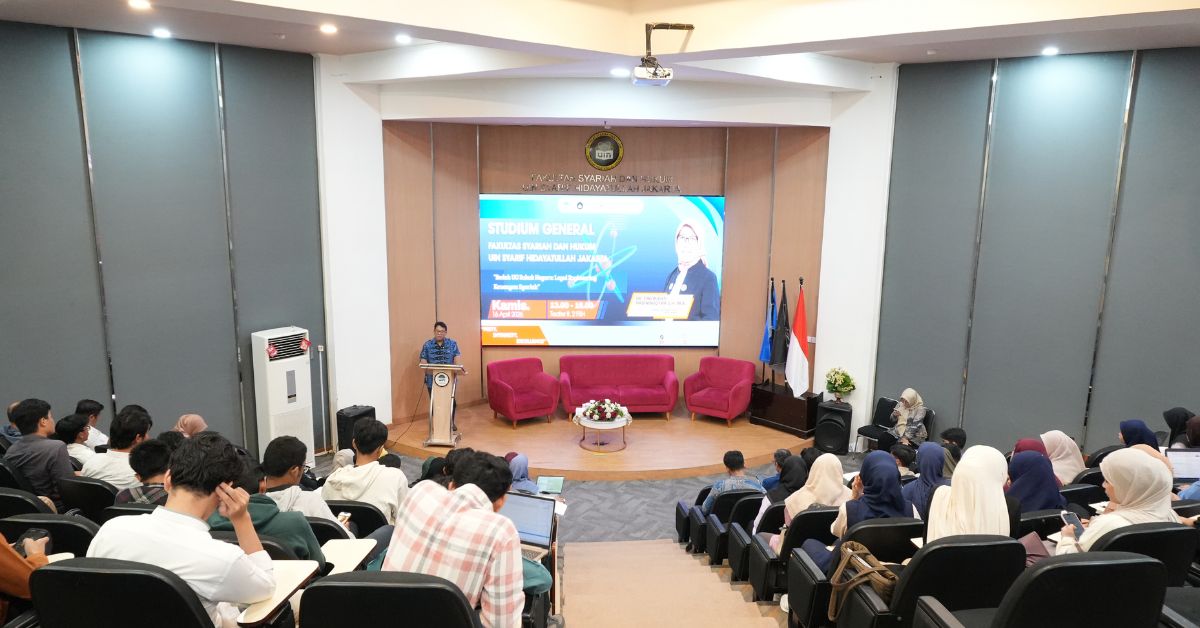
FSH News, 2th Room Theater - The Faculty of Sharia and Law of UIN Syarif Hidayatullah Jakarta organized a Studium Generale entitled “Examining the State Sukuk Law: Legal Engineering in Islamic Finance” on April 16, 2026, at the Faculty’s Second Floor Theater.
The event featured Dr. Dwi Irianti Hadiningdyah, S.H., M.A., a senior practitioner in the fields of law and Islamic finance with more than three decades of experience at the Ministry of Finance of the Republic of Indonesia. The session was moderated by Nuraida, a student of the Master’s Program in Islamic Economic Law.
In his opening remarks, Dr. Afwan Faizin, M.A., Vice Dean for General Administration of the Faculty of Sharia and Law, emphasized the crucial role of law in supporting modern economic systems. He stated that students of the Faculty of Sharia and Law should understand the interrelationship between law, economics, and Islamic finance in order to respond effectively to the dynamics of global developments.
Dr. Nurhasanah, M.Ag., Head of the Master’s Program in Islamic Economic Law, explained that the event was intended to enhance students’ understanding of recent developments in Islamic law and finance in Indonesia, particularly regarding State Sukuk, also known as State Sharia Securities (Surat Berharga Syariah Negara). She noted that these instruments play a strategic role in financing national development while providing an alternative funding mechanism that complies with Islamic principles.
In her presentation, Dr. Dwi Irianti Hadiningdyah explained that State Sukuk are securities issued in accordance with Sharia principles and represent ownership of assets or the beneficial rights arising from such assets. This characteristic distinguishes sukuk from conventional bonds, which are based on debtor-creditor relationships. Consequently, sukuk must comply with the principles prohibiting riba (usury), gharar (uncertainty), and maysir (gambling or speculation).
She further elaborated on the importance of legal engineering in the development of State Sukuk. According to her, the Indonesian legal system initially did not recognize the concept of sukuk, making various legal innovations necessary. These innovations included the adoption of the concept of beneficial ownership, the establishment of Special Purpose Vehicles (SPVs), and the enactment of Law Number 19 of 2008 concerning State Sharia Securities as a specific legal framework for sukuk issuance.
In addition to discussing the legal foundations of State Sukuk, the speaker explained several contractual structures commonly used in sukuk issuance, including ijarah, mudharabah, musyarakah, istisna’, and wakalah. She emphasized that every sukuk issuance must be supported by an underlying asset, consisting of either state-owned assets or government projects. The transfer involved is limited to the transfer of beneficial rights without transferring actual ownership of the assets.
The session also highlighted various innovations in State Sukuk that have been developed by the Indonesian government, including Green Sukuk, Retail Sukuk, Project-Based Sukuk, and Cash Waqf Linked Sukuk. These instruments have contributed significantly to financing infrastructure development, public facilities, and educational projects across Indonesia.
The discussion session was highly interactive and received enthusiastic participation from attendees. Questions covered a wide range of topics, including comparisons between sukuk and foreign loans, default risks, and the potential optimization of community funds through Islamic financial instruments. In response, the speaker explained that State Sukuk offer a high level of security because they are guaranteed by the government and managed through the State Budget (Anggaran Pendapatan dan Belanja Negara).
In closing, Dr. Dwi Irianti Hadiningdyah encouraged students to become problem-solvers in the fields of law and Islamic finance. She emphasized that law graduates have significant opportunities to contribute to the development of the Islamic economy, provided that they are able to adapt to advancements in knowledge and evolving societal needs.
Through this event, the Faculty of Sharia and Law of UIN Syarif Hidayatullah Jakarta hopes that students will gain a deeper understanding of the relationship between law and economics and be encouraged to contribute to national development through innovation in the field of Islamic finance.