
Examining Hajj Readiness 2026: PUSFAHIM UIN Jakarta Holds Public Discussion on Prospects and Challenges Amid Middle East Turmoil
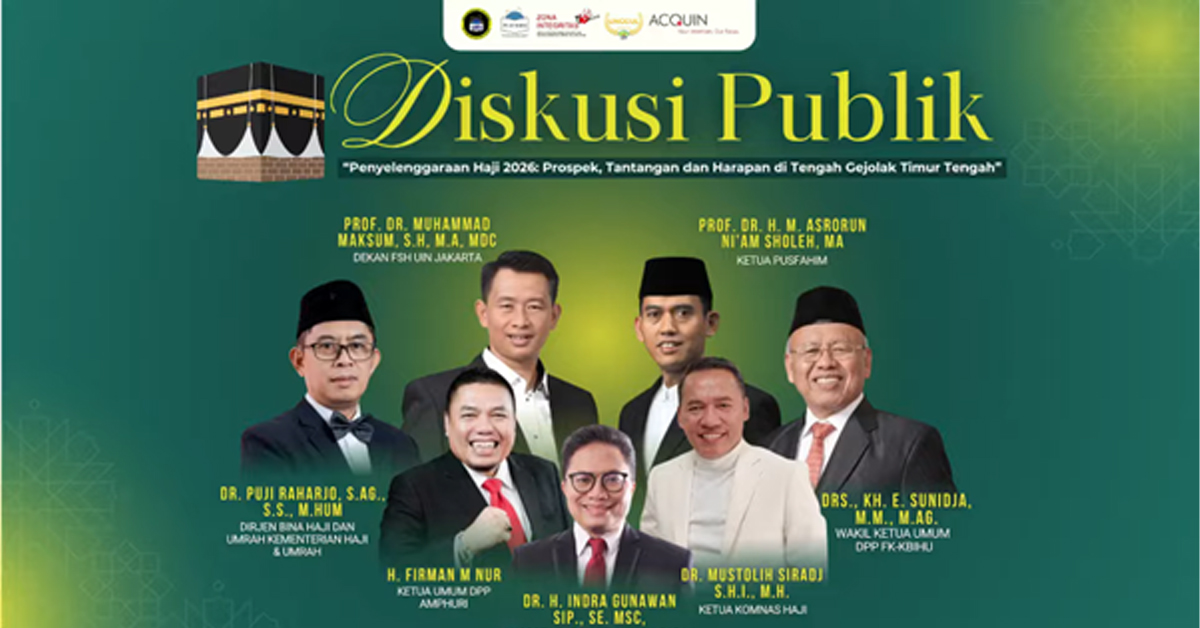
FSH NEWS, Zoom Meeting – The Center for Fatwa and Islamic Law Studies (PUSFAHIM), Faculty of Sharia and Law, UIN Syarif Hidayatullah Jakarta, successfully organized a Public Discussion online via Zoom and live-streamed on YouTube on Saturday, April 18, 2026.
The event, themed “Hajj 2026: Prospects, Challenges, and Hopes Amid Middle East Turmoil”, drew strong attention with more than 250 participants from diverse backgrounds, including prospective pilgrims, religious counselors, Hajj and Umrah Guidance Group (KBIHU) leaders, and academics.
The program was opened by Musa Wardi, S.H., M.H., Executive Secretary of PUSFAHIM, and moderated by Dr. H. Mustolih Siradj, S.H.I., M.H., Chairman of the National Hajj Commission (Komnas Haji) and Head of LKBH FSH UIN Jakarta.
Prof. Dr. Muhammad Maksum, S.H., M.A., MDC, Dean of FSH UIN Jakarta, highlighted the complexity of organizing Hajj 2026, which faces both institutional transition and global geopolitical crises.
“This year’s Hajj is the greatest challenge, being the first experience for the Ministry of Hajj and Umrah, while also confronted with geopolitical tensions amid the unresolved conflict between the US-Israel and Iran,” Prof. Maksum stated.
He emphasized that global uncertainty directly impacts the economy and energy sector, particularly causing a surge in aviation fuel (avtur) prices. On the shariah aspect, he stressed the importance of resolving fiqh issues such as DAM payment management and the implementation of the murur (passing through) scheme in Muzdalifah. He welcomed fatwa formulations from scholars that support the smooth execution of Hajj.
Prof. Maksum closed his remarks by appreciating PUSFAHIM’s role in enhancing FSH UIN Jakarta’s reputation, noting that all nine study programs have now achieved excellent accreditation and international recognition.
Keynote Speaker Prof. Dr. H. M. Asrorun Ni’am Sholeh, M.A., Chairman of PUSFAHIM and Professor at FSH UIN Jakarta, delivered encouraging news regarding Hajj security. He cited his meeting with Saudi Ambassador H.E. Mr. Faisal Bin Abdullah H. Amodi, who assured that the Saudi government fully guarantees the safety of pilgrims, meaning there is no fiqhiyyah impediment (mani’) to performing Hajj.
Prof. Ni’am also emphasized the importance of applying Fiqh Taisir Manhaji (methodological ease based on shariah). “There is a murur scheme at Muzdalifah where pilgrims may remain on buses without disembarking. For elderly or physically challenged pilgrims, this is permissible under shariah, not merely a symbolic overnight stay,” he explained.
The 1447 H / 2026 M Hajj marks a new era with the establishment of the Ministry of Hajj and Umrah (Kemenhaj), created by President Prabowo Subianto.
Dr. K.H. Puji Raharjo, S.Ag., S.S., M.Hum, Director General of Hajj and Umrah, confirmed that preparations are nearly complete. “Starting April 21, pilgrims will enter dormitories, and by April 22, departures to the Holy Land will begin, God willing,” he affirmed.
He also reminded pilgrims to strictly comply with Saudi regulations, including the prohibition against traveling without an official Hajj visa, and stressed the importance of health capability (istita’ah) to reduce mortality rates among pilgrims.
From the private sector, Firman M. Nur, Chairman of DPP AMPHURI, highlighted the transformation of services in the Business-to-Business-to-Consumer (B2BC) era. With Saudi Arabia’s structured Masyar Nusuk digital system, facilities for Special Hajj (hotels, tents) are guaranteed, but demand extraordinary discipline and adaptation from travel associations.
Drs. K.H. E. Sunidja, M.M., M.Ag., Vice Chairman of DPP FK-KBIHU, welcomed government initiatives such as the Murur and Tanazul schemes (relocating some pilgrims to hotels to ease overcrowding in Mina tents), which greatly benefit elderly pilgrims.
From a financial perspective, Dr. H. Indra Gunawan, SIP., SE., MSc, Member of BPKH Executive Board, stressed the need for long-term strategies. He proposed shifting from procurement spending to investment. “With Rp 180 trillion in funds, it would be strategic for BPKH to invest in Saudi service companies (syarikah), thereby enhancing our bargaining power and national dignity,” he suggested.
The event concluded past midnight with lively audience engagement, featuring critical questions on aviation fuel price hikes, efficiency of Hajj officers, and fairness in benefit fund distribution.
All stakeholders agreed to synergize in ensuring the success of Hajj 2026, with the ultimate goal of pilgrims returning as Hajj Mabrur.