
Family Law Festival 2026 Presents National Talkshow on Husband–Wife Equality After Constitutional Court Ruling
FSH News, Theater 2nd Floor – The Student Association of the Family Law Study Program (HMPS Hukum Keluarga), Faculty of Sharia and Law, UIN Syarif Hidayatullah Jakarta, organized a National Talkshow as part of the Family Law Festival (FLF) 2026, carrying the theme “Dialectics of Law and Husband–Wife Equality After Constitutional Court Decision No. 159/PUU-XXIV/2026.” The event took place at the Faculty’s 2nd Floor Theater and was attended by students, lecturers, and participants from diverse backgrounds.
The opening session was solemn, marking the start of an academic discussion on gender equality issues in family law. Welcoming remarks were delivered by Tsalsa Fajriatul Izza, Vice Chair of HMPS Family Law, representing the Chair. She expressed appreciation for the participants’ presence and explained that the National Talkshow was one of the main agendas of FLF 2026, aimed at raising students’ sensitivity to the dynamics and developments of legal issues in society.
Ali Mansur, M.A., Secretary of the Family Law Study Program, praised the committee for successfully organizing the four-day festival. He emphasized that learning does not only occur in classrooms but also through student organizational activities that foster responsibility, leadership, and critical thinking. He also congratulated the winners of the competitions held during FLF 2026.
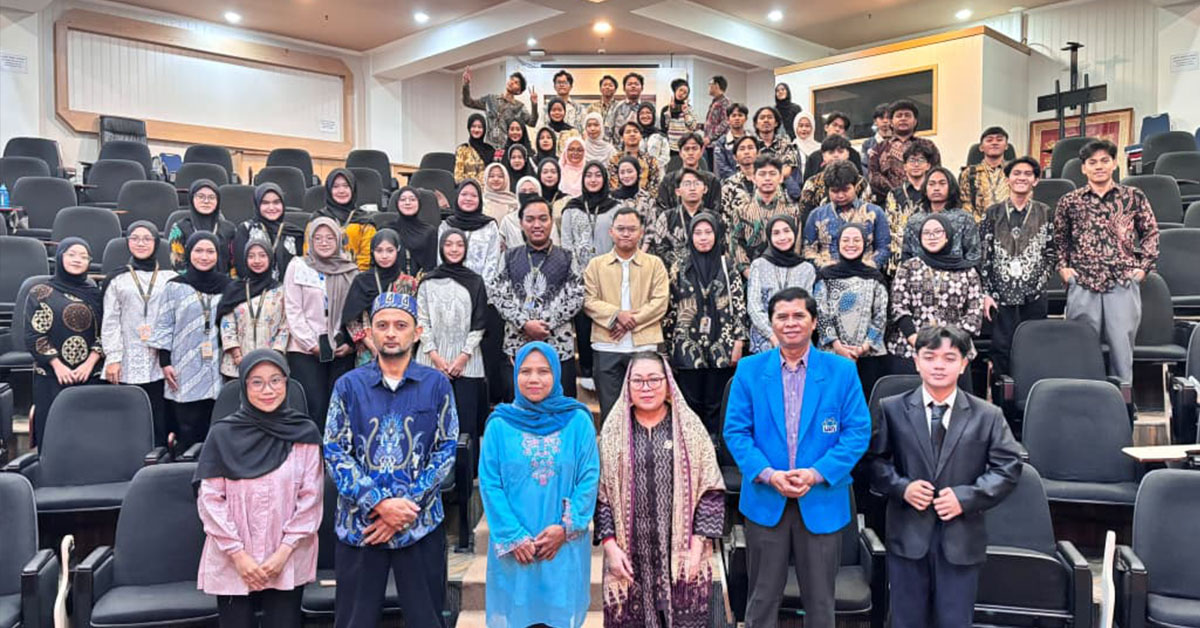
Prof. Dr. Kamarusdiana, M.A., Vice Dean for Student Affairs, Alumni, and Cooperation, highlighted that the speakers were experienced activists and advocates for women’s issues, with strong theoretical and practical expertise. He also touched on the policy development regarding the marriage age limit, which has been raised to 19 years, but still requires supportive measures in education and community empowerment. Prof. Kamarusdiana symbolically closed the Family Law Festival 2026, followed by a prayer led by Aziz Bimantara and a group photo session.
The main talkshow session was moderated by M. Fakhri Abror, who introduced the two speakers: Ratna Batara Munti and Nur Rofiah.
Ratna Batara Munti, in her presentation “Dialectics of Law and Husband Wife Equality After Constitutional Court Decision No. 159 of 2026,” explained the mandate of Komnas Perempuan in preventing, monitoring, and addressing violence against women. She outlined the definition of discrimination against women under the CEDAW Convention and examined provisions in Law No. 1 of 1974 on Marriage, particularly Article 31(3) and Article 34, which designate the husband as head of the family and the wife as household manager. She argued that such role fixation risks perpetuating gender injustices such as marginalization, subordination, stereotyping, domestic violence, and the double burden on women. She concluded by reviewing Constitutional Court Decision No. 159/2026, which rejected the petition to review Article 34. While the Court dismissed the case, she noted that its legal reasoning still leaves room for criticism as it does not fully address entrenched gender roles in marital relations.
Meanwhile, Nur Rofiah presented “Qiwamah and Wilayah in the Perspective of Women’s True Justice.” She explained gender relations in Islam through the concepts of guardianship (wilayah) and responsibility (qiwamah), covering all phases of family life from pre-marriage to post-marriage. She emphasized that men and women are equally complete human beings with spiritual, intellectual, and physical dimensions. She introduced the concept of the Lens of Women’s True Justice, distinguishing biological experiences (menstruation, pregnancy, childbirth, postpartum, breastfeeding) from social experiences (stigmatization, marginalization, subordination, violence, and double burdens), which often lack adequate recognition.
She further analyzed changes in gender relations by comparing religious norms with social realities, addressing issues such as lineage, financial support, marriage contracts, dowry, guardianship, inheritance rights, and child custody. As an alternative, she proposed a family paradigm based on mutual protection, shifting from control-oriented relations to equal, fair, and mutually empowering partnerships between men and women. She concluded by stressing the importance of building families rooted in Islamic values as a form of devotion to Allah SWT.
The session continued with an interactive discussion. Three participants Nadya, Ummi Hasanah, and Revita Putri Sadewi—posed questions that were comprehensively answered by the speakers. The participants’ enthusiasm reflected strong interest in family law, gender equality, and national legal developments.
As appreciation for active participation, the committee distributed door prizes to questioners. The event concluded with the presentation of certificates of appreciation to the speakers by HMPS Family Law organizers, followed by a group photo. At exactly 11:53 WIB, the Master of Ceremony officially closed the National Talkshow of Family Law Festival 2026.
Through this National Talkshow, HMPS Family Law hopes that Family Law Festival 2026 will not only serve as a competition platform but also as an academic space fostering critical thought on the development of family law in Indonesia. The event underscores the importance of scholarly dialogue in responding to legal dynamics and realizing family relations that are more just, equal, and fair.