
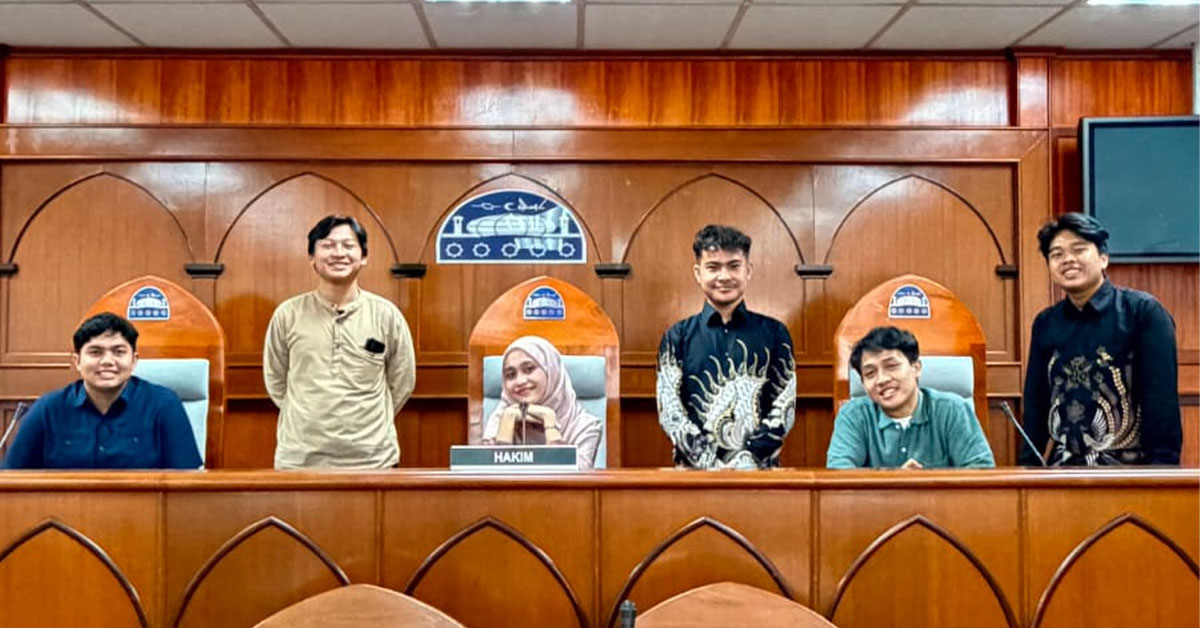
FSH UIN Jakarta Comparative Mazhab Students Test Contemporary Legal Research at Universiti Malaya
FSH News, Kuala Lumpur – Issues of legal protection for victims of sexual violence in universities and early-age marriage in Indonesia and Malaysia became the focus of research presented by students of the Faculty of Sharia and Law (FSH), UIN Syarif Hidayatullah Jakarta, in an international academic forum at the Academy of Islamic Studies, Universiti Malaya (APIUM), Tuesday, August 4, 2026.
As part of the International Student Mobility program, students from the Comparative Mazhab Study Program of FSH UIN Jakarta presented their research before Universiti Malaya academics. The forum provided space for students to test their ideas, receive academic feedback, and compare legal issues developing in Indonesia and Malaysia.
The event was divided into two presentation sessions, each addressing contemporary legal issues. One study examined legal protection for victims of sexual violence in higher education, while another analyzed early-age marriage in Indonesia and Malaysia.
Tengku Chintya Khairunnisa and Muhammad Hadzami Alma’arif presented “Reconstructing Legal Protection for Victims of Sexual Violence in Higher Education: An Analysis of Power Imbalances and the Paradox of Locker Room Talk in the Digital Era.”
Their research highlighted legal protection challenges for victims of sexual violence in universities, focusing on power imbalances and the phenomenon of locker room talk in the digital age.
Through a Comparative Mazhab perspective, they sought to broaden the analysis by combining legal approaches with social contexts. The presentation sparked discussion on how legal systems can provide effective protection for victims while fostering safe and just academic environments.
Harun Arrasyid, M. Fathul Husein, and Salfaz Rafiqasya presented “Comparative Analysis of Early-Age Marriage in Indonesia and Malaysia.”
This study examined early-age marriage, a persistent issue in both countries. While Indonesia and Malaysia share social and legal traditions, they apply different legal approaches to regulating marriage.
The comparison highlighted how differences in regulation and legal frameworks impact child and family protection. Interactive discussions allowed students to gain new perspectives from Malaysian academics on issues also faced in Indonesia.
The students’ research presentations received responses from Universiti Malaya academics. Assoc. Prof. Dr. Mohd Zaidi bin Daud, Head of the Department of Sharia and Law at APIUM, led the discussion, joined by Dr. Moh Haidz (Department of Sharia and Law) and Dr. Osman (Department of Siyasah).
Their feedback enriched the discourse with cross-disciplinary perspectives. Questions, critiques, and suggestions became vital parts of the students’ research development, offering them experience in defending arguments before international academics.
The FSH UIN Jakarta delegation was led by Prof. Dr. Kamarusdiana, M.H., Vice Dean for Student Affairs, Alumni, and Cooperation, accompanied by lecturers Prof. Asmawi and Dr. Qosim Arsyadani.
Prof. Kamarusdiana expressed appreciation for APIUM’s hospitality and emphasized that such academic activities strengthen institutional ties and open broader collaboration opportunities. Dr. Mohd Zaidi bin Daud welcomed the program, noting that student exchanges enrich perspectives on Islamic law dynamics regionally and globally.
The International Student Mobility program, held August 4–8, 2026, was part of the Memorandum of Agreement (MOA) between FSH UIN Jakarta and APIUM. In addition to presenting research, students joined academic discussions and Focus Group Discussions (FGDs) on contemporary Islamic law and comparative Sharia judicial systems in Indonesia and Malaysia.
The participation of Comparative Mazhab students in Universiti Malaya’s academic forum demonstrated that student mobility offers more than inter-university exchanges. It provided opportunities to bring Indonesian legal issues into international academic conversations and to understand similar challenges from Malaysian perspectives.
For FSH UIN Jakarta, this experience reflects efforts to build an academic culture that encourages students to research, discuss, compare legal systems, and communicate ideas internationally.
Through strengthened networks with Universiti Malaya, FSH UIN Jakarta continues to expand opportunities for students to broaden their horizons, build academic networks, and develop Islamic legal research responsive to societal issues.
From Universiti Malaya’s academic forum, FSH UIN Jakarta students not only presented research but also brought Indonesian scholarly perspectives into dialogue with the international academic community.