
Legal Ethics Expert Leads Interactive Guest Lecture at UIN Jakarta
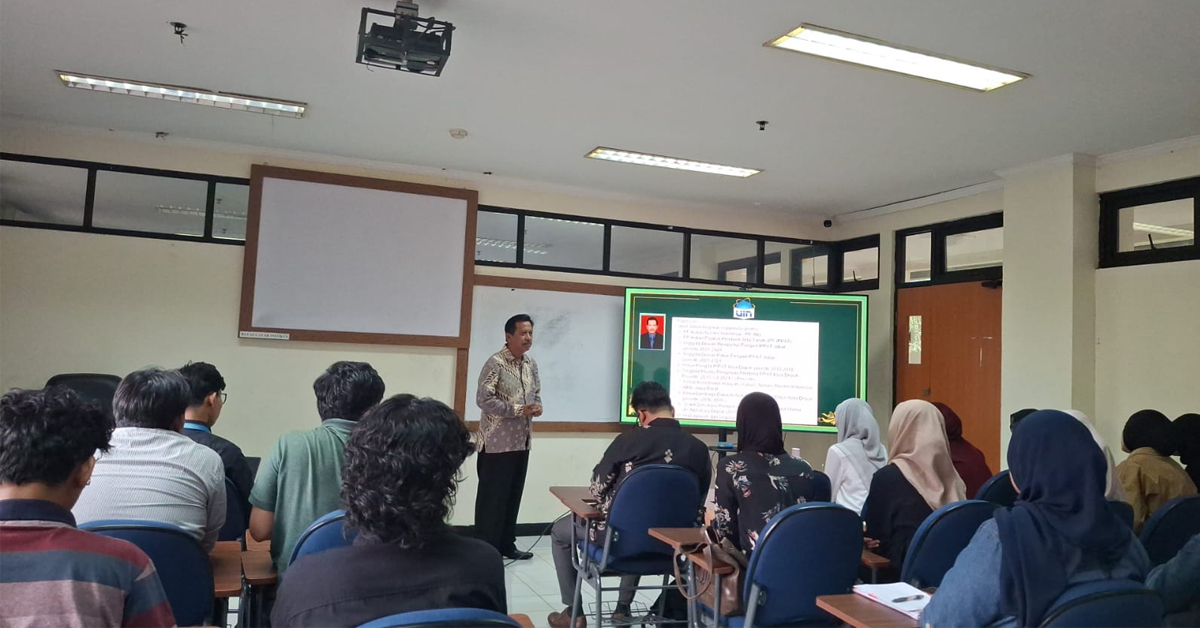
FSH News, Lecture Room — A warm yet intellectually engaging academic atmosphere characterized the Legal Professional Ethics course at the Faculty of Sharia and Law (FSH), UIN Syarif Hidayatullah Jakarta. Serving as a guest lecturer, Dr. Drs. Chairul, S.H., S.Pn., M.Kn., a multidisciplinary expert in law, defense strategy, and national leadership, delivered a special lecture to students of the Constitutional Law (HTN) Study Program.
Unlike a conventional public lecture held in a large auditorium, the session on Wednesday (May 6) was conducted in a more intimate and interactive setting, with 35 selected students attending the compulsory course.
The presence of Vice Dean for Student Affairs and Cooperation, Prof. Kamarusdiana, M.H., further enriched the academic session. In his brief remarks at the beginning of the class, Prof. Kamarusdiana emphasized the importance of mastering professional ethics for future law graduates, particularly those specializing in constitutional law, whose professional responsibilities often intersect with issues of power and constitutional governance.
“Classes like this provide a fertile environment for critical discussion. I hope these 35 HTN students can make the most of Mr. Chairul’s experience and insights, because in the future, you will play an important role in upholding ethical standards in the public and constitutional spheres,” he said before inviting the guest lecturer to begin the session.
Seated together in a circular classroom arrangement, Dr. Drs. Chairul immediately engaged the students through a dialogue-based approach that explored various ethical dilemmas in the legal profession. He specifically connected the discussion to constitutional law, including ethical violations by public officials, conflicts of interest in policymaking, and the roles of the Constitutional Court and other judicial institutions.
“Constitutional law governs relations of power. Without ethics, power can become an instrument of tyranny. As future constitutional law professionals, you must be able to distinguish between what is legal and what is ethical, because the two do not always coincide,” he emphasized.
The classroom became increasingly dynamic during the question-and-answer session. Students raised critical questions, including how a civil servant within a ministry should respond if a superior proposes discriminatory regulations, as well as the ethical dilemma faced by a court clerk who is asked by an executive official to disclose confidential judicial information.
Dr. Drs. Chairul responded to each question carefully, drawing on practical examples and professional experiences while offering students applicable ethical frameworks for addressing complex situations. Throughout the discussion, Prof. Kamarusdiana occasionally contributed additional perspectives, particularly from the standpoint of institutional and public policy considerations, creating a constructive academic dialogue rarely found in regular classroom sessions.
After nearly three hours of discussion, the students expressed their appreciation for the learning experience. Representing his 35 classmates, the HTN Class Representative said, “We are accustomed to studying theories from textbooks, but meeting a practitioner of Mr. Chairul’s experience, together with the guidance of Prof. Kamarusdiana, helped us understand that ethics is not merely a theoretical doctrine. It is an essential part of our everyday professional lives in the future.”
At the end of the session, Dr. Drs. Chairul encouraged students to continuously develop their ethical awareness and remain committed to professional integrity rather than being easily influenced by material incentives.
Through the guest lecture, FSH UIN Jakarta reaffirmed its commitment to strengthening legal professional ethics through contextual, interactive, and practice-oriented learning. The Faculty hopes that similar activities can be held regularly across other study programs, allowing more students to develop not only strong legal knowledge but also the ethical values necessary to contribute responsibly to society and public life.