
Masykuri Abdillah: Political Fiqh Must Be Contextual, State Form Is Not a Frozen Doctrine
FSH News, FSH Meeting Room - Professor of UIN Syarif Hidayatullah Jakarta, Prof. Masykuri Abdillah, emphasized that political fiqh is an area of ijtihad open to change and development over time. According to him, Islam provides principles and fundamental values in political life but does not prescribe a single state form to be uniformly applied across all Muslim societies.
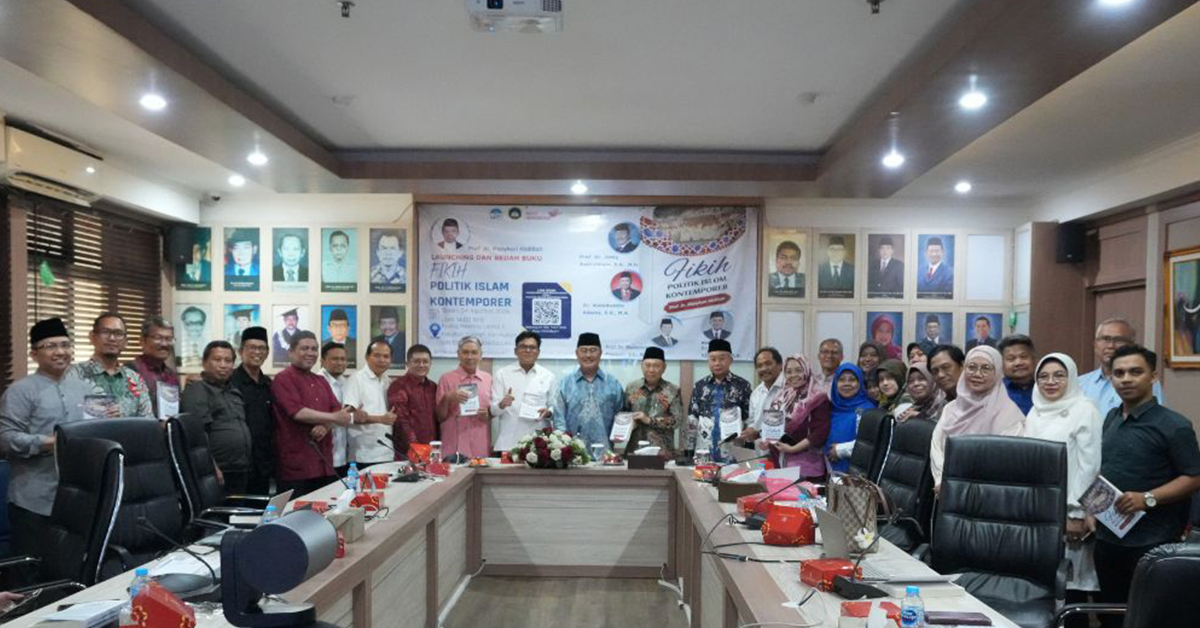
This view was conveyed by Prof. Masykuri during the Book Review of Contemporary Islamic Political Fiqh organized by the Faculty of Sharia and Law (FSH), UIN Syarif Hidayatullah Jakarta, on Monday, August 24, 2026. The event was held in hybrid format, attended both onsite and online by UIN Jakarta’s academic community.
The book Contemporary Islamic Political Fiqh examines issues of state and citizenship by bringing together Islamic thought, modern political theory, legal studies, and contemporary social developments.
Prof. Masykuri explained that political fiqh cannot simply be formulated by transferring classical political concepts into today’s realities. Religious texts must be read with attention to the context in which opinions emerged, societal developments, and current challenges. "We must look at text, context, and interpretation what was the context then, what is it now, and how should we respond," he said.
-
Islamic vs. Muslim States: Prof. Masykuri distinguished between an Islamic state (formally adopting sharia as positive law) and a Muslim state (majority Muslim population but not necessarily labeled Islamic). This distinction prevents the assumption that all Muslim-majority countries must share identical institutions.
-
Khilafah and Democracy: He argued that khilafah should not be seen as the only valid form of Islamic governance, while democracy contains principles—consultation, participation, accountability—that resonate with Islamic political traditions, though adapted to local contexts.
-
Opposition: He recognized opposition as permissible within contemporary political fiqh, provided it functions as constructive oversight aligned with amar ma’ruf nahi munkar.
-
Jihad: He rejected interpretations of jihad as unlimited offensive war, stressing contextual readings of Qur’anic verses on warfare, tied to defense and historical circumstances.
Scholarly Responses
-
Prof. Jimly Asshiddiqie: Supported Masykuri’s contextual approach, urging integration of fiqh and modern legal theory. He noted that khilafah must be understood historically, while modern systems should be judged by their substance justice, accountability, citizen protection rather than terminology.
-
Dr. Wahiduddin Adams: Highlighted Indonesia’s constitutional and legal experiences as valuable resources for developing Islamic political theory, including religious courts and incorporation of sharia principles into legislation.
-
Prof. Asep Saepudin Jahar (Rector): Praised the book’s authenticity and integration of Islamic studies with contemporary law and politics, calling it a significant academic contribution from UIN Jakarta.
The book review, moderated by Dr. Asrori S. Karni, lasted nearly three hours with lively discussion from around 30 participants onsite and additional attendees online. The event became not only a book introduction but also a forum for academic dialogue on the future of Islamic political fiqh in modern state contexts.