
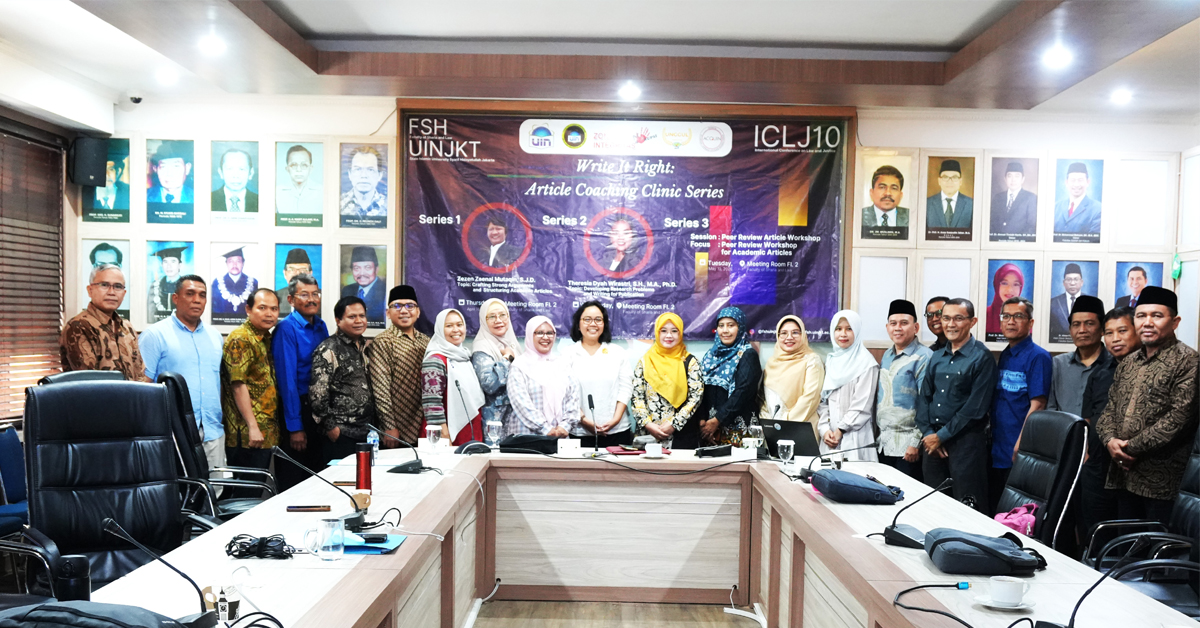
Pre-ICLJ 10th Coaching Clinic at FSH UIN Jakarta Strengthens Research and Academic Publication Quality
SH News, 2nd Floor Meeting Room — The Faculty of Sharia and Law (FSH), UIN Syarif Hidayatullah Jakarta, reaffirmed its commitment to improving the quality of research and academic publications through the Coaching Clinic: Developing Research Problems and Writing for Publication, held on Wednesday, May 6, 2026, in the faculty’s 2nd-floor meeting room. The activity was part of the pre-event series leading up to the 10th International Conference on Law and Justice (ICLJ), an annual academic forum organized by FSH.
The event opened with remarks and guidance from Vice Dean for Academic Affairs, Prof. Dr. Mesraini, M.Ag. In her remarks, she emphasized that ICLJ is a strategic faculty agenda that serves not only as a platform for disseminating knowledge but also as a means of encouraging the academic community to produce high-quality publications in reputable journals. She added that the coaching clinic is an important stage in refining academic manuscripts before they are submitted to conference forums and indexed journals, including Scopus-indexed publications, which remain one of the institution’s targets.
“This activity is expected to strengthen the participants’ academic spirit and encourage them to produce high-quality scholarly works with global competitiveness,” she said.
The session featured Theresia Dyah Wirastri, S.H., M.A., Ph.D., an academic with an extensive publication record and a strong citation profile, as the speaker. She provided an in-depth discussion on strategies for formulating research problems and techniques for academic writing aimed at publication. Moderated by Dr. Indra Rahmatullah, S.H.I., M.H., the coaching clinic was conducted interactively, with participants demonstrating strong enthusiasm throughout the session.
In her presentation, Theresia emphasized the importance of formulating clear and focused research problems. She explained that research problems can emerge from literature reviews, previous studies, or field observations. According to her, good research should follow a coherent, logical, and focused structure, supported by relevant research questions that address issues of genuine academic importance.
She also introduced the FINER framework—Feasible, Interesting, Novelty, Ethical, and Relevant—as a tool for developing high-quality research questions. This framework is considered important to ensure that research is not only feasible but also capable of making a meaningful contribution to the advancement of knowledge.
Research ethics also became a key focus of the session. Theresia highlighted the principle of “Do No Harm,” which includes protecting the identities of informants, being sensitive to respondents’ psychological conditions, applying informed consent, and avoiding stigmatization in research findings. “Research must not cause harm to any party, and its benefits should outweigh its risks,” she emphasized.
Furthermore, she explained the stages involved in formulating research questions, beginning with conducting a literature review and determining the scope of the study, followed by articulating specific research questions. She also reminded participants to avoid overly broad questions and encouraged the use of a socio-legal approach through questions such as “why,” “how,” and “to what extent.”
The discussion session proceeded dynamically, with participants raising a variety of questions. One participant highlighted challenges in obtaining data for research in Islamic economic law. In response, Theresia explained that using initials to identify research subjects may be permitted as part of ethical research practices, while data validation can be strengthened through comparisons with previous studies and comprehensive literature reviews.
Another question addressed the use of artificial intelligence (AI) in academic writing. Theresia explained that AI may be used as an assisting tool, such as for summarizing literature, but the conceptual framework and analysis must remain the author’s own. She also noted that institutions such as the University of Indonesia have utilized tools including Turnitin and Copyleaks to support academic integrity.
Through this activity, FSH UIN Syarif Hidayatullah Jakarta hopes that participants will further enhance the quality of their research and academic publications while preparing to contribute to the 10th International Conference on Law and Justice (ICLJ). The coaching clinic also reflects the Faculty’s continued commitment to fostering a strong, competitive, and integrity-driven academic culture.