
Prof. Jimly Asshiddiqie Encourages Integration of Fiqh and Legal Studies in Islamic Universities
FSH News, Meeting Room 2nd Floor — Constitutional law scholar Prof. Jimly Asshiddiqie urged Islamic universities to pursue deeper integration between fiqh and legal studies. According to him, such integration is necessary so that Islamic political thought can address modern state issues without being trapped in the dichotomy between religious knowledge and knowledge derived from human historical experience.
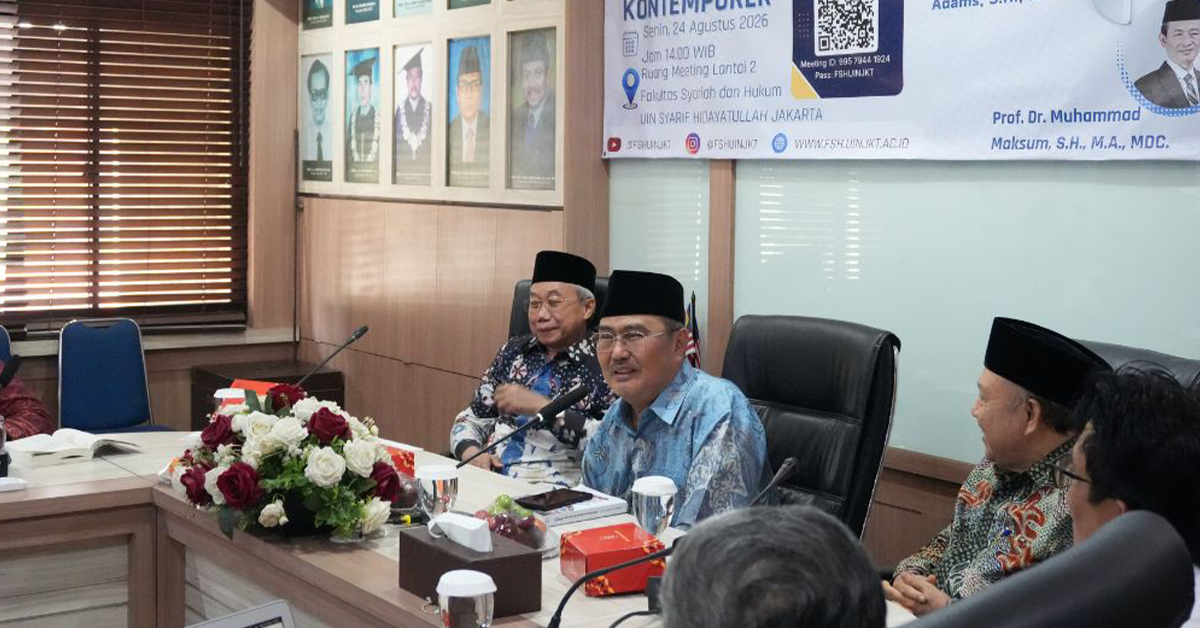
Jimly conveyed this during the book review of Contemporary Islamic Political Fiqh by Prof. Masykuri Abdillah, organized by the Faculty of Sharia and Law (FSH) at UIN Syarif Hidayatullah Jakarta, Monday (August 24, 2026).
“Our responsibility as intellectuals is to integrate legal science with fiqh. Many aspects of law and fiqh need to be carefully integrated,” Jimly stated.
He explained that integration should not be limited to using Qur’anic verses or hadith as supplements to modern legal theory. Instead, it must be built at the level of paradigm, concept, method, and interpretation of human historical experience.
Jimly distinguished two major sources of knowledge: ayatullah (divine revelation) and sunnatullah (laws of life understood through human scientific discovery). Thus, the intellectual heritage of philosophers such as Plato and Aristotle can be seen as part of humanity’s effort to understand sunnatullah.
“Human history is part of sunnatullah. Therefore, we should not dismiss a theory as un-Islamic simply because it originates outside the Islamic world,” he said.
He emphasized that this approach is crucial for legal development, since modern law has evolved through the long experiences of various civilizations. At the same time, Islamic tradition also offers valuable contributions to legal and democratic theory, such as the practice of consultation (shura) during the Prophet Muhammad’s era. The Prophet did not pass down authority hereditarily, and leadership succession after his death was decided through deliberation among companions.
This, Jimly argued, provides material for understanding republicanism and consultation in Islamic history. Meanwhile, in ancient Greece, democracy faced criticism, leading Plato to stress nomocracy—rule bound by norms.
“Even the best of people, if not governed by norms and not subject to a system of rules, are not ideal,” he asserted.
Therefore, Jimly concluded that political fiqh studies should not merely repeat classical terminology or pit Islamic thought against Western theories. Scholars must find points of convergence between law, democracy, religion, constitutionalism, human rights, and social experience.
He noted that Muslim-majority countries also grapple with the relationship between state law and Islamic law. Indonesia itself has achieved forms of integration through legislation on zakat, hajj, Islamic banking, halal product assurance, waqf, and Islamic economics.
“One day, everything may be Islamic in substance, even if not labeled as Islamic. But this is an intellectual struggle spanning centuries. Progress must be made decade by decade,” Jimly remarked.
Prof. Masykuri Abdillah explained that his book was indeed written with the paradigm of knowledge integration, combining Islamic thought, political theory, legal studies, and social sciences in discussions on the state, constitution, democracy, citizenship, international relations, state finance, jihad, opposition, and political ethics. He stressed that modern concepts cannot be ignored but must be critically examined in light of texts, their historical context, and current societal needs.
Dr. Wahiduddin Adams, another discussant, supported further development of the book’s ideas. He emphasized the importance of drawing from Indonesia’s constitutional and legislative experience, not only classical Islamic heritage or post–World War II political developments. Each chapter, he noted, could serve as a basis for independent research themes.
UIN Rector Prof. Asep Saepudin Jahar praised Masykuri’s work as a demonstration of knowledge integration, which has long been a core orientation of Islamic higher education. He encouraged lecturers to continue producing authentic academic works amid society’s growing reliance on instant information and artificial intelligence.
In closing, Jimly expressed hope that the book review would not remain a mere academic forum but spark an intellectual movement, including curriculum development that integrates fiqh and legal studies. He stressed that the future of Islamic political studies lies not in repeating old debates but in providing new answers to issues of statehood, law, democracy, environment, and humanity.
The event was held both onsite and online, attended by around 30 members of UIN Jakarta’s academic community. Present onsite were Dean Prof. Muhammad Maksum, Vice Deans Prof. Kamarusdiana and Dr. Afwan Faizin, and Head of the Doctoral Program in Sharia Studies Prof. Yayan Sopyan. Online participants included Vice Rector I Prof. Ahmad Tholabi and Head of the Center for Fatwa and Islamic Law Studies (Pusfahim) Prof. Asrorun Ni’am. The discussion, moderated by Dr. Asrori S. Karni, lasted nearly three hours with dynamic audience engagement.