
Prof. Kamarusdiana Highlights the Future of Islamic Family Law in Indonesia at International Forum USIM
FSH News, Negeri Sembilan – Divorce, underage marriage, and issues of alimony and protection for women and children continue to pose challenges in the development of Islamic family law in Indonesia. Amid increasingly complex social changes, law is required not only to provide normative certainty but also to deliver justice and public benefit.
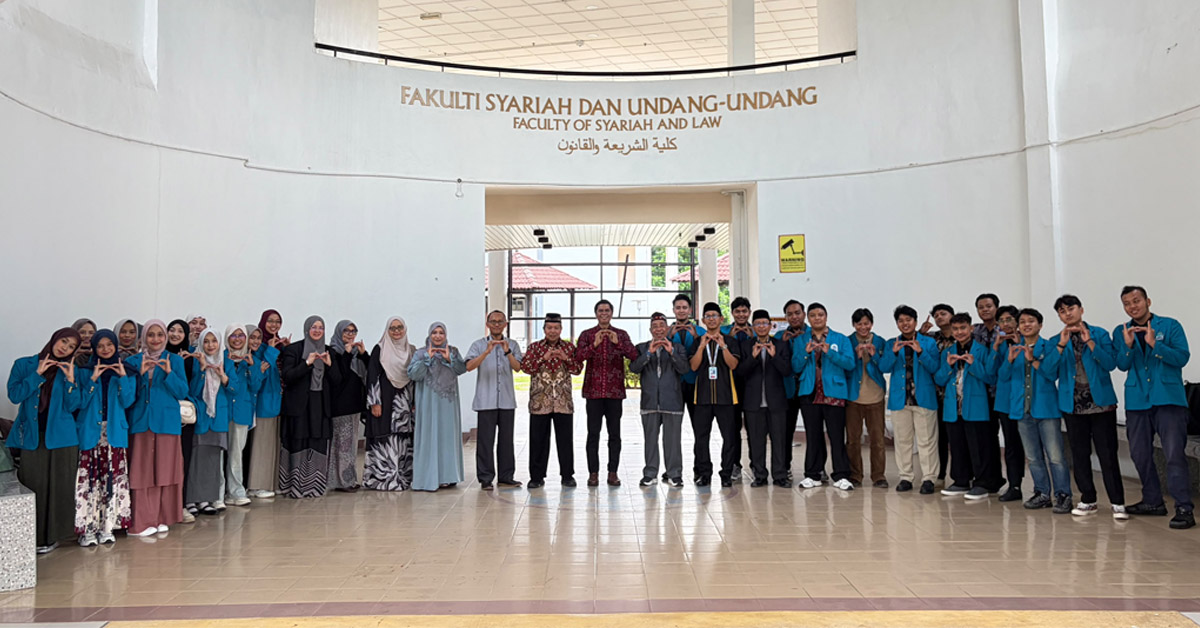
These issues were the focus of Prof. Dr. Kamarusdiana, M.H., lecturer at the Faculty of Sharia and Law (FSH), UIN Syarif Hidayatullah Jakarta, when he appeared as a presenter at the International Discourse Syariah and Law Series 2 at Universiti Sains Islam Malaysia (USIM) on Wednesday, August 5, 2026.
In this academic forum, which brought together academics and students from Indonesia and Malaysia, Prof. Kamarusdiana presented the theme “Contemporary Issues in Family Law in Indonesia.” He invited participants to view family law from a broader perspective, combining legal norms, social dynamics, and the evolving needs of society.
According to him, Islamic family law in Indonesia cannot be separated from the social realities in which it is applied. Therefore, renewing perspectives on fiqh munakahat is essential to ensure that the law remains relevant and able to address concrete issues faced by society. "In practice, Islamic family law in Indonesia does not exist in a vacuum. It constantly interacts with the social, economic, and cultural realities of society. Thus, a rereading of fiqh munakahat rules is necessary so they do not lose relevance and a sense of justice," he explained.
Prof. Kamarusdiana outlined several current challenges in Indonesian family law: rising divorce rates, underage marriages, and issues of women’s and children’s rights. He also presented case studies from religious courts, including polygamy, alimony, and division of marital property. These cases show that family law often encounters complex social conditions that cannot be resolved solely through normative approaches.
He argued that such issues require multidisciplinary approaches, combining ushul fiqh, sociology of law, and public policy to produce more comprehensive legal understandings. This ensures family law does not stop at legal-formal compliance but also considers impacts and justice experienced by parties, especially women and children.
His presentation evolved into a comparative discussion of family law in Indonesia and Malaysia. The forum allowed participants to explore how two countries with historically close Islamic legal traditions address family issues through their respective institutional frameworks and legal approaches.
From USIM, the event was attended by Assoc. Prof. Dr. Nisar Mohammad Ahmad, Deputy Dean for Student Affairs, along with lecturers and students. Enthusiasm was evident during two discussion sessions, with USIM students asking critical questions about differences in family law systems, judicial practices, and Indonesia’s handling of Muslim family issues.
The dialogue went beyond comparing systems, becoming a space for mutual learning on how Islamic law can be developed to address changing societal challenges. The exchange of perspectives showed that family law issues transcend national boundaries, with divorce, child protection, alimony, and family relations being common challenges faced by Muslim societies worldwide.
Prof. Kamarusdiana’s participation in this international forum also reinforced FSH UIN Jakarta’s role in building regional academic networks. As Vice Dean for Cooperation, his involvement was part of efforts to expand scholarly collaboration between UIN Jakarta and partner universities in Malaysia.
The International Discourse Syariah and Law Series 2 served not only as a platform for presenting academic ideas but also as a medium of scholarly diplomacy, connecting Indonesian and Malaysian academic traditions.
For FSH UIN Jakarta, international collaboration is a vital part of enhancing education quality and research development. Cross-national exchanges of ideas, experiences, and perspectives are expected to open broader opportunities for cooperation in research, publications, faculty exchanges, and student mobility.
Through such forums, FSH UIN Jakarta continues to promote sharia and legal studies that are not only strong in normative aspects but also contextual, responsive to social change, and oriented toward justice.
This Indonesia–Malaysia academic dialogue is expected to be a sustainable step in building an open, progressive scholarly ecosystem capable of contributing to resolving Muslim family issues in Southeast Asia.