
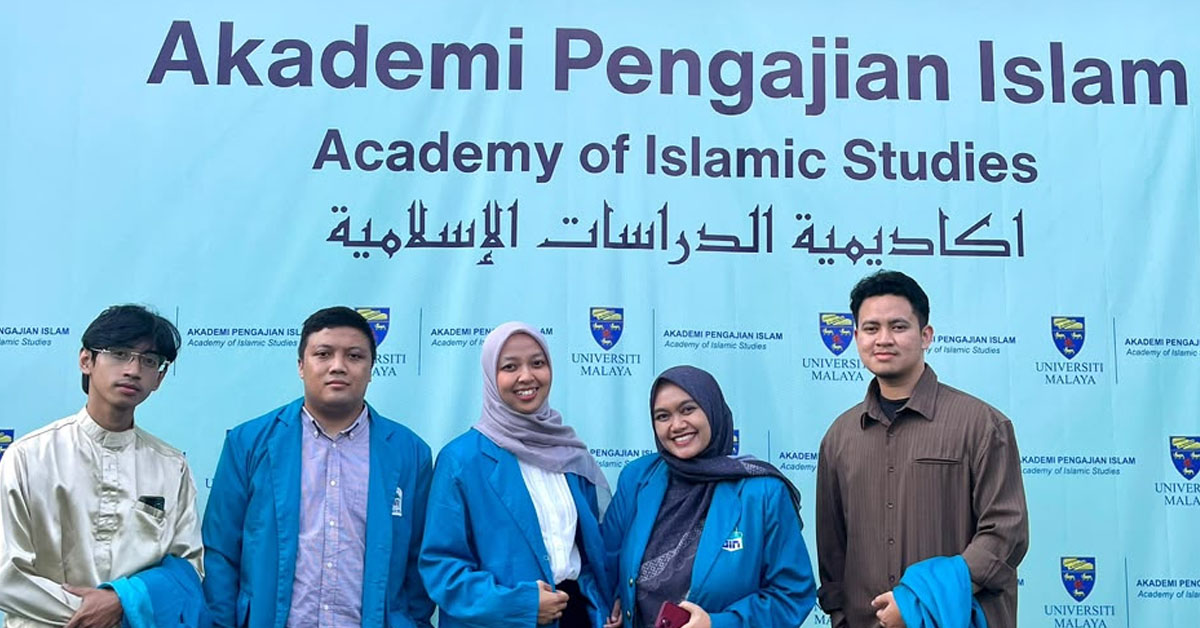
Six Master’s Students of HES FSH UIN Jakarta Present Three Islamic Economic Law Research Projects at International Forum Universiti Malaya
FSH News, Kuala Lumpur – Not just participants, six students of the Master’s Program in Islamic Economic Law (HES), Faculty of Sharia and Law (FSH), UIN Syarif Hidayatullah Jakarta, brought their research into the international academic arena at the Academy of Islamic Studies, Universiti Malaya (APIUM), Kuala Lumpur, Tuesday, August 4, 2026.
In this academic forum, the six students presented three studies addressing strategic issues in Islamic economic law, ranging from sharia banking disputes, the concept of riba in philosophical and public welfare perspectives, to the relationship between religion and the state in halal product legislation.
The six students were divided into three presentation groups.
-
Group One: Muhamad Febrianto and Ayyasy Muhammad presented “Litigation Authority Models in Resolving Sharia Banking Disputes in Indonesia and Malaysia.” Their study compared judicial authority in handling sharia banking disputes in both countries, highlighting jurisdictional overlaps between Indonesia’s Religious Courts and Malaysia’s Sharia Courts, as well as opportunities for harmonizing dispute resolution systems.
-
Group Two: Anggi Ristiani and Fathinah Afifah Iswahyunisa presented “Riba in the Perspective of Utilitarianism and Maslahah.” They examined riba not only from normative-theological perspectives but also through utilitarian philosophy and maslahah theory, suggesting that the prohibition of riba can be understood in terms of welfare, benefit, and protection of public interests.
-
Group Three: Nuraida Fitriani and Aryo Purboyo Wisnuwardhana Baiquni presented “Religion–State Relations in Halal Product Legislation in Indonesia.” Their research analyzed the dynamics between religious authority and the state in halal product assurance, focusing on the roles of the Indonesian Ulema Council (MUI) and the Halal Product Assurance Agency (BPJPH) in ensuring legal certainty, consumer protection, and national economic interests.
Together, the three studies showcased the breadth of HES students’ perspectives, spanning legal, philosophical, institutional, and policy approaches to Islamic economic law.
The student presentations sparked dynamic discussions with Malaysian academics and practitioners. The forum featured Assoc. Prof. Dr. Mohd Zaidi bin Daud (Head of the Department of Sharia and Law, APIUM), Dr. Osman (Department of Siyasah), Sasymi (Malaysian advocate), and Dr. Moh. Hafidz (Department of Sharia and Law).
They provided critiques, questions, and feedback on each study, testing the students’ arguments and methodologies while offering new perspectives on how Islamic economic law issues are understood in Indonesia and Malaysia.
This interaction gave students valuable academic experience, allowing their research ideas developed in Indonesia to be tested in an international scholarly environment. It also highlighted that Islamic economic law issues are cross-border in nature, influenced by global developments in sharia banking, economic transactions, halal regulation, and legal thought.
The student delegation was accompanied by lecturers including Prof. Dr. Kamarusdiana, M.H., Prof. Dr. Asmawi, M.Ag., and Dr. KH. Qosim Arsyadani, M.A. Their presence underscored FSH UIN Jakarta’s support for students’ academic capacity development, particularly in research and international scholarly communication.
For the students, presenting at Universiti Malaya was more than an academic journey—it was an opportunity to defend arguments, accept critique, view research from different perspectives, and build networks with academics and practitioners abroad.
This activity also strengthened academic ties between FSH UIN Jakarta and Universiti Malaya, which continue to grow through student mobility, joint research, faculty exchanges, and international publications.
The academic forum at APIUM demonstrated that FSH UIN Jakarta students have space to bring Indonesian Islamic economic law issues into global academic conversations.
The three studies showed that Islamic economic law is not limited to normative debates but intersects with judicial systems, legal philosophy, state regulation, consumer protection, and global economic dynamics.
Through cross-national academic experiences like this, FSH UIN Jakarta continues to encourage students to conduct deep research, test ideas internationally, and contribute Indonesian perspectives to the global development of Islamic economic law.
Looking ahead, these experiences are expected to help HES Master’s students produce higher-quality research that is relevant to societal needs and contributes to the advancement of Islamic economic law at national, regional, and international levels.