
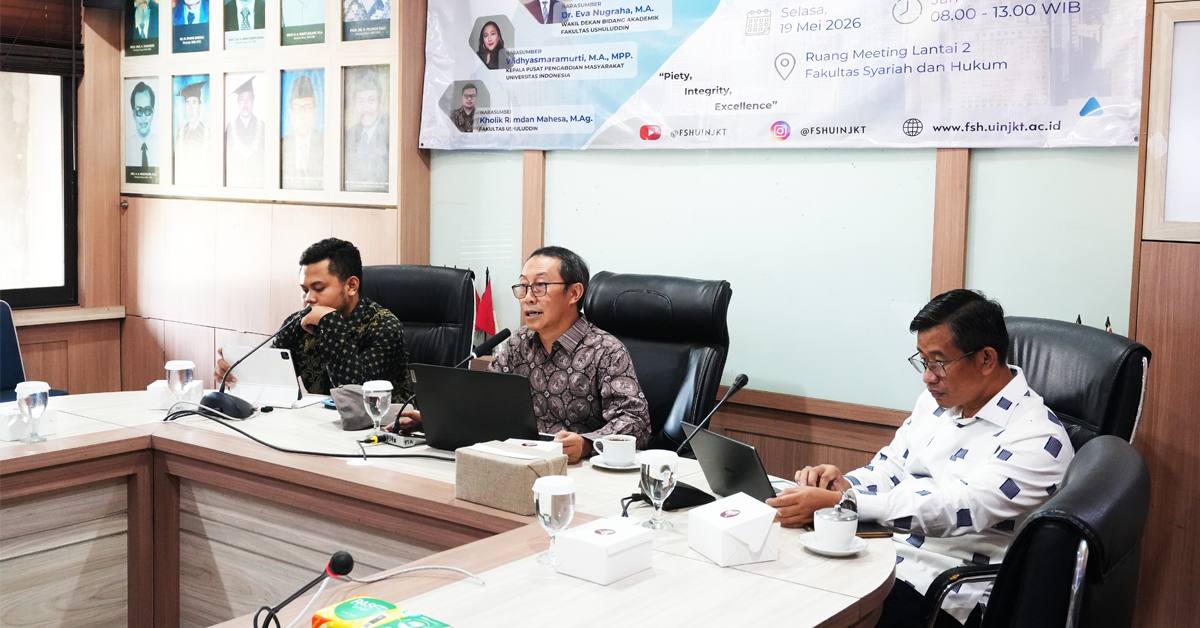
Strengthening the Tridharma Mission, FSH UIN Jakarta Holds Community Engagement Training
FSH News, Faculty Meeting Room — In an effort to strengthen the implementation of the Tridharma of Higher Education, particularly in the area of community engagement, the Faculty of Sharia and Law (FSH), UIN Syarif Hidayatullah Jakarta, held a Community Engagement Methods Training on Tuesday, May 19, 2026, at the Faculty Meeting Room.
The training was attended by Dean of FSH Prof. Muhammad Maksum, Vice Deans Prof. Kamarusdiana and Prof. Mesraini, as well as lecturers from across the Faculty of Sharia and Law. The presence of the faculty leadership demonstrated strong institutional support for strengthening lecturers’ competencies in developing innovative, participatory, and impactful community engagement programs.
The training featured two experienced speakers, Dr. Eva Nugraha and Dr. Wisdyaamarawati, Head of the Center for Community Engagement at the University of Indonesia. During the sessions, the speakers introduced various approaches and methods of community engagement currently applied in academic and social empowerment programs.
The main topics included Participatory Action Research (PAR), Asset-Based Community Development (ABCD), and Community-Based Research (CBR). These three approaches are considered relevant to community engagement programs because they position communities as active participants and key actors in processes of social change and community development.
The speakers explained that Participatory Action Research (PAR) emphasizes active community involvement throughout all stages of a program, from identifying problems and designing programs to implementation and evaluation. Through this approach, communities are not merely recipients of programs but are actively involved in determining the direction of change according to their circumstances and needs.
Meanwhile, Asset-Based Community Development (ABCD) focuses on strengthening the assets and potential already present within communities. The approach encourages communities to identify local strengths that can be developed as social, economic, and cultural resources to foster community self-reliance. According to the speakers, ABCD is particularly relevant for empowerment programs built around local potential.
The Community-Based Research (CBR) approach was described as a collaborative research model involving academics and communities. Under this approach, community members participate directly in the research process, ensuring that the resulting research is not only academically valuable but also capable of providing practical solutions to issues faced by the community.
In his remarks, Dean of FSH Prof. Muhammad Maksum expressed his appreciation to the speakers for sharing their knowledge and experiences with the Faculty’s lecturers. He emphasized that community engagement is an important part of the academic responsibility of higher education institutions and must continue to be developed professionally and sustainably.
He added that the training is expected to strengthen lecturers’ ability to design community engagement programs that are more focused, responsive to community needs, and capable of generating tangible social impact. High-quality community engagement, he noted, can also strengthen the role of universities in addressing various social challenges faced by society.
Throughout the training, participants actively engaged in each session. Interactive discussions emerged as lecturers shared their experiences in implementing community engagement programs in various regions and with different communities. The speakers also presented examples of good practices from successful community engagement initiatives implemented in several areas.
In addition to the presentations, the program featured question-and-answer sessions and group discussions on designing community engagement programs based on PAR, ABCD, and CBR. Participants were given opportunities to explore how these approaches could be applied according to their respective academic disciplines and the characteristics of their target communities.
The training proceeded smoothly and was marked by a strong academic spirit. Participants expressed their hope that similar activities could be held on a regular basis to continuously improve the quality of community engagement initiatives at FSH UIN Syarif Hidayatullah Jakarta.
Through this training, FSH UIN Syarif Hidayatullah Jakarta seeks to develop community engagement programs that are increasingly innovative, collaborative, and impactful, while strengthening the contribution of higher education institutions to community development and social life.