
Symbiotic Relations Between Intelligence and Political Parties Could Strengthen Democracy
FSH News, Theater 2nd Floor – Regulating the relationship between intelligence agencies and political parties carries significant importance in safeguarding democracy. A symbiotic relationship is considered capable of contributing to the health of democracy. Conversely, the politicization of intelligence risks eroding democratic values.
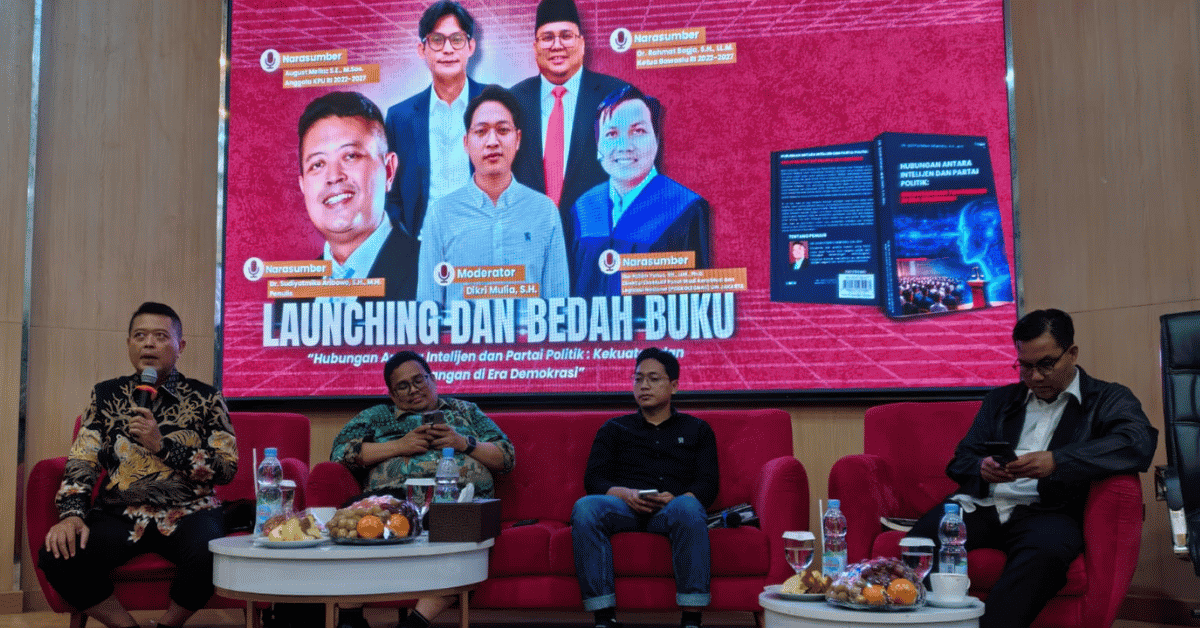
This issue emerged during the launch and discussion of the book “The Relationship Between Intelligence and Political Parties: Strengths and Challenges in the Democratic Era” by Sudiyatmiko Aribowo, organized by the Student Association of the Constitutional Law Study Program (HMPS HTN) at UIN Syarif Hidayatullah Jakarta, Thursday (9/7/2026).
The event was attended by Chairman of Bawaslu RI, Rahmat Bagja; HTN lecturer at UIN Jakarta, Nur Rohim Yunus; Vice Dean of the Faculty of Sharia and Law, Afwan Faizin; Head of the Law Study Program, Fitria, Ph.D.; and UIN Jakarta students.
Author Sudiyatmiko Aribowo stated that the way to encourage a symbiotic relationship between intelligence and political parties is through transparency. “Transparency is the only bridge that separates productive synergy from destructive politicization in the relationship between intelligence and political parties,” he said.
Furthermore, Miko (as he is known) emphasized that productive synergy between intelligence and political parties will strengthen democracy if there is a clear and firm boundary between state interests and electoral interests. “Because the politicization of intelligence is not merely an ethical violation, but an existential threat to public trust in the entire democratic system,” Miko stressed.
The book, consisting of eight chapters, serves as a guide for academics and practitioners as an academic foundation for making strategic decisions requiring valid data. “This book is presented as an academic and practical guide for scholars, policymakers, and intelligence practitioners,” Miko explained.
Meanwhile, Chairman of Bawaslu RI, Rahmat Bagja, noted that elections are not only contested at the ballot box but also involve information and power. “This book dissects the relationship between intelligence and political parties not merely as a matter of national security, but directly linked to electoral integrity, political competition equality, and the quality of democracy,” Bagja said.
He further explained that in every electoral contest, strategic information becomes a highly valuable resource. Therefore, he added, there is potential for competing interests over intelligence information. “Information on voter preferences, political dynamics, potential conflicts, and security threats holds crucial value in political decision-making,” Bagja emphasized.
HTN lecturer at UIN Jakarta, Nur Rohim Yunus, remarked that political parties absolutely need a supply of strategic intelligence data as the basis for knowledge-based decision-making. However, Rohim reminded that such relations must be built on legal foundations. “The relationship between political parties and intelligence must be based on legal coordination, not secret commands from those in power,” Rohim asserted.