
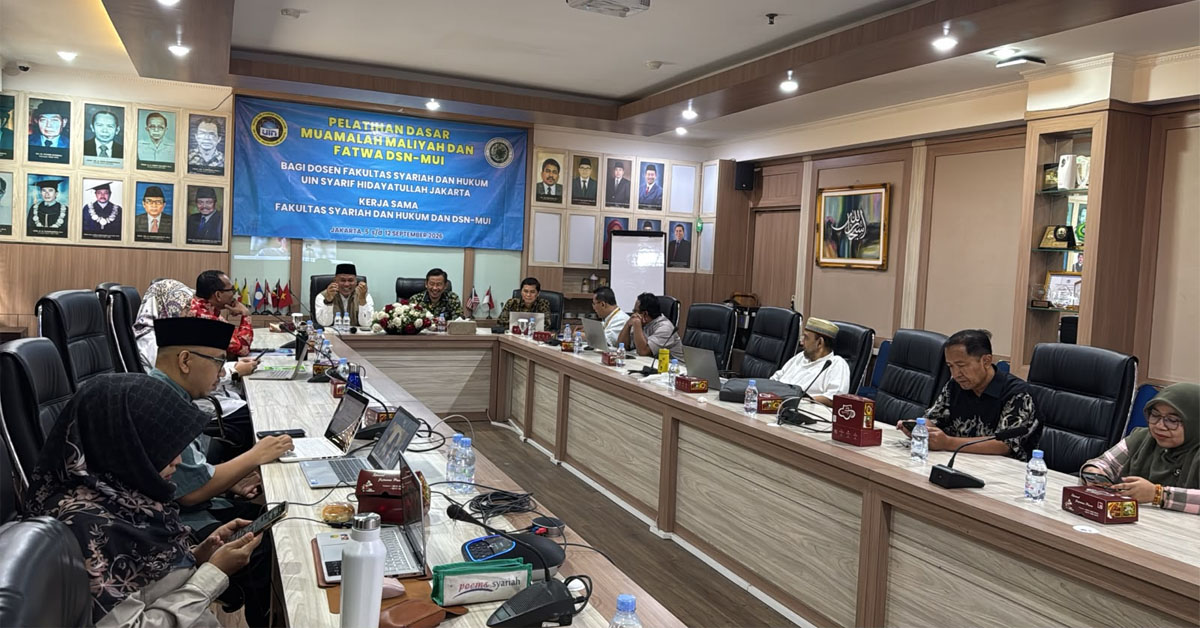
UIN Jakarta and DSN-MUI Strengthen Lecturer Competence through Basic Training on Muamalah and Fatwa
FSH News, FSH Meeting Room — To strengthen both theoretical and practical understanding in Islamic economics, 20 lecturers from the Faculty of Sharia and Law (FSH) at UIN Syarif Hidayatullah Jakarta participated in the Basic Training on Muamalah and Fatwa, held from September 5–12, 2026.
The training was organized in collaboration between FSH UIN Jakarta and the National Sharia Council of the Indonesian Ulema Council (DSN-MUI). This initiative represents a strategic step to enhance lecturers’ capacity and competence, particularly in understanding the concept of muamalah, the methodology of fatwa issuance, and the evolving practices of Islamic economics and finance.
The growing complexity of the Islamic finance industry requires strengthened academic understanding that is not only theoretical but also responsive to real-world issues and practices. This training was therefore designed to bridge academic perspectives with industry experience in Islamic finance.
Dean of FSH UIN Jakarta, Prof. Dr. Muhammad Maksum, S.H., M.A., M.D.C., officially opened the event. He reaffirmed his commitment to continuously facilitate academic competence development for lecturers as part of efforts to improve the quality of education and learning at FSH.
“Enhancing lecturer capacity is the key to maintaining the quality of learning. This training combines academic depth with the realities of the sharia industry,” said Prof. Maksum.
He emphasized that strengthening lecturer competence is crucial to ensuring that teaching materials remain relevant to scholarly developments and professional needs. With a more comprehensive understanding of muamalah and fatwa, lecturers are expected to develop contextual learning processes and foster responsive academic studies on Islamic economics.
Chairman of DSN-MUI, K.H. Muhammad Cholil Nafis, Lc., Ph.D., expressed appreciation for the collaborative initiative outlined in the Cooperation Agreement (PKS) between the two institutions. He hoped that the collaboration would extend beyond training to include academic activities and human resource development in sharia and Islamic economics.
Over six days, participants received comprehensive materials from leading experts and practitioners. Topics included:
-
Introduction to DSN-MUI and Islamic Finance — covering the role of regulators and the development of Islamic Financial Institutions (LKS).
-
Fiqh Muamalah and Methodology — deepening Ushul Fiqh and Qawaid Fiqhiyyah to address modern financial issues.
-
Sharia Contracts — exploring transaction structures and contemporary fatwas.
Prominent speakers included K.H. Sholahudin Al Aiyub, M.Si., Dr. Mochammad Bukhori Muslim, M.A., Ah. Azharuddin Lathif, M.Ag., M.H., Muhammad Gunawan Yasni, S.E., M.M., Hidayatulloh, Ph.D., and Dr. Aini Masruroh, M.M.
The training sessions were interactive and filled with enthusiasm. Lively discussions emerged around case studies of contracts and new fatwas, allowing participants to connect the material with teaching needs and research development. This interaction enriched lecturers’ perspectives on the dynamics of Islamic economics, which requires analysis that integrates theory, industry developments, societal needs, and sharia principles.
Through this training, FSH UIN Jakarta and DSN-MUI hope lecturers will not only master classical theory but also be prepared to guide the future of Islamic economics through relevant teaching and research. Strengthened competence is expected to contribute to improved learning quality and reinforce FSH’s role in advancing sharia scholarship and Islamic economic law.
The collaboration also reflects efforts to build synergy between universities and authoritative sharia institutions. This synergy is expected to continue in supporting academic development, research, and human resource capacity to meet future challenges in Islamic economics.