
UIN Jakarta Students Enthusiastically Join Sharia Capital Market Education with IDX, OJK, KSEI, and Securities
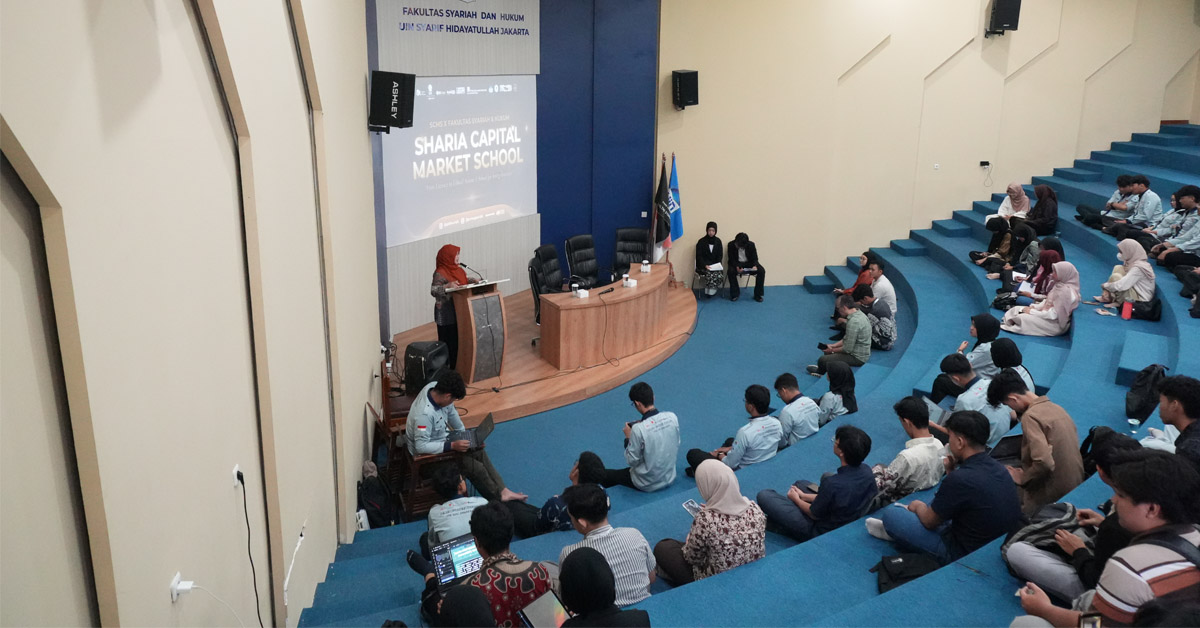
FSH News, 6nd Floor Room Teather - The Student Executive Board of the Faculty of Sharia and Law (DEMA FSH) and the Student Executive Board of the Faculty of Economics and Business (DEMA FEB), under the organization Sharia Capital Market School (SCMS), held a Sharia Capital Market Education Program on Wednesday, June 24, 2026, at the 6th Floor Theater Room of the Faculty of Sharia and Law, UIN Syarif Hidayatullah Jakarta.
The program aimed to improve students’ literacy and understanding of the sharia capital market while providing broader insights into the development of the sharia financial industry in Indonesia. Participants had the opportunity to learn directly from practitioners and stakeholders about concepts, regulations, and practices of sharia-compliant investment.
The event was officially opened by Prof. Dr. Mesraini, S.H., M.Ag., Vice Dean for Academic Affairs of FSH, representing the faculty leadership. In her remarks, she expressed appreciation to DEMA FSH, DEMA FEB, and all collaborators for organizing the educational initiative. She emphasized that law students must understand the development of sharia economics and capital markets not only from an economic perspective but also from legal and sharia perspectives.
“Students should not only master theory but also be able to observe and understand practices developing in society. Literacy in sharia economics and capital markets must be continuously improved so that students gain a comprehensive understanding of the sharia financial industry,” she stated.
The program featured speakers from key institutions in the capital market and sharia finance sector:
-
Laraza Annisa, IDX Sharia Business Development
-
M. Fikri Fauzan, OJK – PEPK and LMST, OJK Banten Representative Office
-
Akbar Pamungkas, Phillip Securities Indonesia
-
Anggita Silviani Dewi, KSEI – Investor Service Education Division
In their presentations, the speakers explained crucial aspects of the sharia capital market, including industry developments, regulations and supervision by the OJK, mechanisms of sharia-compliant investment, and the roles of the IDX and KSEI in supporting the national investment ecosystem.
Students showed strong enthusiasm throughout the event, actively engaging in discussions and Q&A sessions on sharia investment opportunities, investor protection, and the growing diversity of sharia financial instruments in Indonesia.
Through this program, DEMA FSH and DEMA FEB hope students will gain a deeper understanding of the importance of sharia financial literacy and be able to utilize sharia investment instruments wisely, safely, and in accordance with sharia principles.
The Sharia Capital Market Education Program reflects the synergy between student organizations and industry stakeholders in supporting the development of high-quality, adaptive human resources with strong knowledge of sharia economics and finance in Indonesia.